
What you will learn
On this pageContentsCloseOpen
A customer in Berlin bought a €200 jacket from your US store and wants to send it back. You open the order, click Return, and reach Return shipping options. There are two choices: Upload a return label and No shipping required. The third one — Create a return label in Shopify — is not offered.
That is not a misconfiguration and not a plan gate. The Shopify Help Center states it flatly: "Return labels are available only for US domestic orders." Elsewhere it is precise about what domestic means — the option "is available only if your primary location and customer shipping address are both in the United States." Both ends. A UK store cannot buy a UK-to-UK return label in Shopify either.
The second thing on this order is more interesting, because most of what circulates about it is wrong. You collected duties at checkout under delivered duty paid (DDP), and the common claim is that Shopify cannot refund them. It can — in the admin and through the Admin API. What it cannot do, and says so in its own documentation, is get that money back from Germany.
The constraint is a US-domestic rule, not carrier geography
The usual misreading is "Shopify Shipping doesn't operate in Europe." The rule is narrower: it is about the return label product specifically, and it is symmetric. The same page lists the other exclusions in one sentence — "You can't buy return labels for US military addresses (APO/FPO/DPO), US territories that require a customs form, or international addresses in Shopify" — and points you elsewhere: "If you're shipping from a fulfillment location that isn't in the United States, then you can buy return labels directly from a shipping carrier or through a shipping app."
So the native path for Berlin is to buy a label from a carrier, attach the PDF or URL through Upload a return label, and hand-key the tracking number. Three frictions come with it: labels are order-level, not item-level; "in-admin tracking statuses such as 'Delivered' aren't available for return labels"; and "return fees aren't automatically deducted from refunds," so your restocking fee is subtracted by hand every time. For a handful of returns a month that is still a rational operating model. We covered where the native flow stops in the limits of Shopify's self-serve returns and exchanges; the label is the one artifact it cannot produce.
Shopify refunds duties. Recovering them is a different problem
Open the refund screen on an order carrying duties and you will find checkboxes for Duties and import taxes on refunded items and Additional fees: Customs clearance. At the API level, order.suggestedRefund and refundCreate accept refundDuties, with a refundType of PROPORTIONAL or FULL. One hedge: that shopify.dev guide carries a Shopify Markets developer-preview banner about generated duty values, so verify the API path against your own store before building on it.
Now the part nobody writes about. Refunding the duty line moves money from you to the shopper. Recovering it is a separate, manual, non-guaranteed process against a foreign government. Shopify says that for low-value goods tax you must "contact the country or region's tax authority to recover the tax that you've remitted," and for import tax you "contact the country or region's customs authority." Then the sentence that should end most vendor arguments: "import taxes that have been paid to a country or region's customs authority aren't always recoverable."
Shopify's admin solves the first problem. Nothing solves the second. For how the duties were collected, see what Shopify's checkout duties and DDP labels actually cover.
Exchanges are blocked on exactly the orders where they would help most
The commercial answer to a €200 cross-border return is an exchange, so the revenue stays. Natively you cannot: "You can't add exchange items to orders with duties, but you can create a return for orders with duties." If you sell DDP, that is every international order. Shopify Plus merchants can activate exchanges through the feature test drive, but the restriction is a property of the order, not the plan.
Managed Markets changes the outbound leg and nothing else
Many US merchants assume that making Global-e the merchant of record moves returns off their desk. Shopify: "Returns and refunds for Managed Markets orders are managed by you in your Shopify admin, the same as your other orders," and "You can purchase a return label for Managed Markets orders from a third-party provider or carrier."
Then it gets worse for the P&L. Post-fulfillment, "refunds aren't provided for duties, customs fees, or VAT" — the one thing native Shopify does on the duty line, Managed Markets removes. Exchange is not a workaround either: "A product exchange is considered as a new Managed Markets order that needs to go through customs. You or your customer need to pay duties and taxes for the second time." It is an outbound compliance product, and a merchant using it needs a returns app more than one who does not.
How seven returns apps actually source an international label
The useful question is not whether an app says "international returns" — nearly all do — but how the label gets made, because that decides which of your lanes work. Four models exist across the set: a first-party negotiated network, your own carrier contract connected directly, a third-party aggregator you connect, and RMA only with no label.
| App | How the label is sourced | Documented origin coverage |
|---|---|---|
| Loop Returns & Exchanges | Ship By Loop network; your own carrier (BYOA) | 478 lanes, 67 origin / 30 destination countries |
| ReturnGO Returns & Exchanges | Ship by ReturnGO; own contracts on Premium+; Shippo, Sendcloud, ShipStation, Easyship | 15 named countries, select routes |
| ReturnZap Returns & Exchanges | Shipping by ReturnZap; direct carrier accounts on Advanced+; EasyPost, Sendcloud, Shippo, ShipStation | US, Canada, UK, Australia, Europe |
| Return Prime:Return & Exchange | Your own carrier accounts plus customs documents | Not stated |
| AfterShip Returns & Exchanges | Easyship, resold as a sandboxed sub-account; own carriers | 11 origin countries; destinations broader |
| CWILL Returns & Exchanges | Your own carriers; Sendcloud, Shippo, ShipStation named | Not stated |
| Redo | First-party network, "labels in 200+ countries" | Managed Returns origins: Canada, US, UK, AUS |
One finding cuts across all seven: none of them route international labels through Shopify Shipping. There is nothing to pass through. Every vendor must build a network, resell an aggregator, or use your contract.
Loop Returns & Exchanges
Source: Shopify App Store listing — captured September 3, 2026
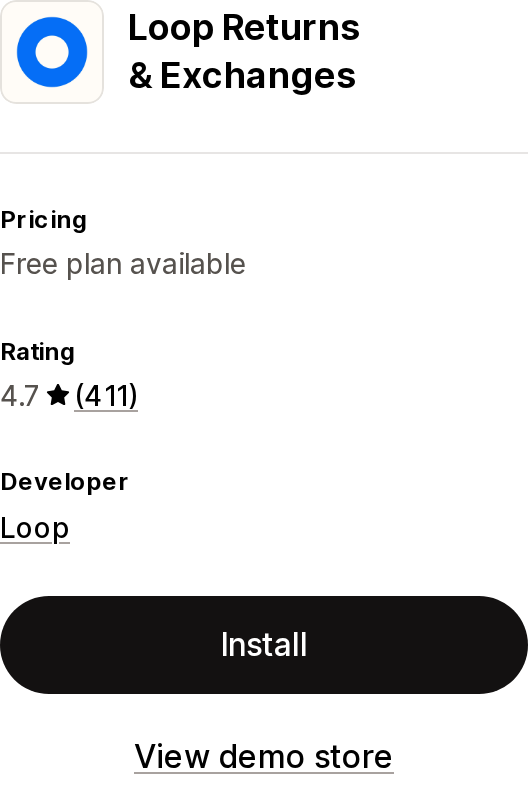
4.7 from 411 reviews. Checkout+ is free, Essential $155/month, Advanced $340/month. Loop documents the widest lane coverage here and its FAQ says "cross-border shipping is available on all Loop plans," though the listing describes the free tier as covering "US & Canada domestic return labels" — confirm your tier first.
The prerequisites are the real story, and Loop is blunt: "If customs information is not entered in Shopify, then the label will fail." That means HS code, country of origin, weight and SKU on every variant, and requires_shipping = false on non-physical items. There is a hard ceiling too — "packages entering the US must be worth less than $2500." And International Lite, despite the name, "does not support generating international labels."
ReturnGO Returns & Exchanges
Source: Shopify App Store listing — captured September 3, 2026
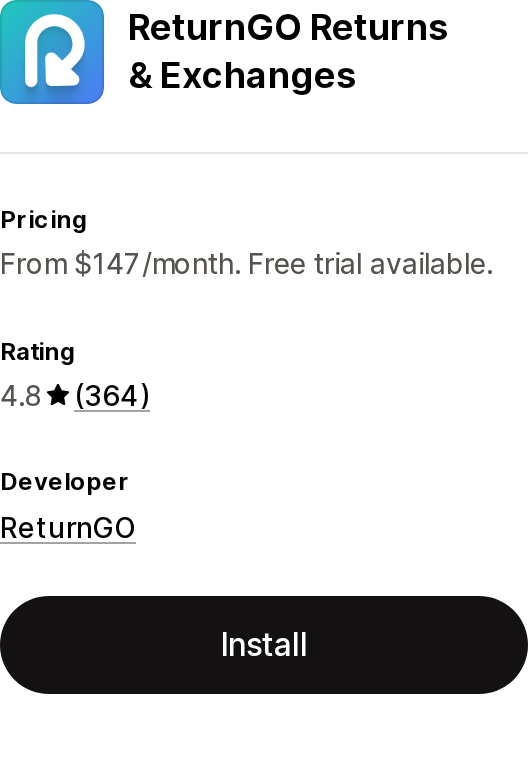
4.8 from 364 reviews, no free plan. Premium is $147/month with 110 returns included and $1.25 per extra; Pro is $297/month with 300 included at $0.90. Ship by ReturnGO is the first-party source, documented with DDP and commercial invoices across 15 named countries.
It also publishes the most useful disclosure in the category, and it is a warning about its own product: "Reverse labels are standard shipping labels used for returns that may not be classified as returned merchandise by customs. As a result, these shipments may be subject to import duties, taxes, or brokerage charges." That is what off-list routes get. Note too: "there is currently no test mode for label generation."
ReturnZap Returns & Exchanges
Source: Shopify App Store listing — captured September 3, 2026
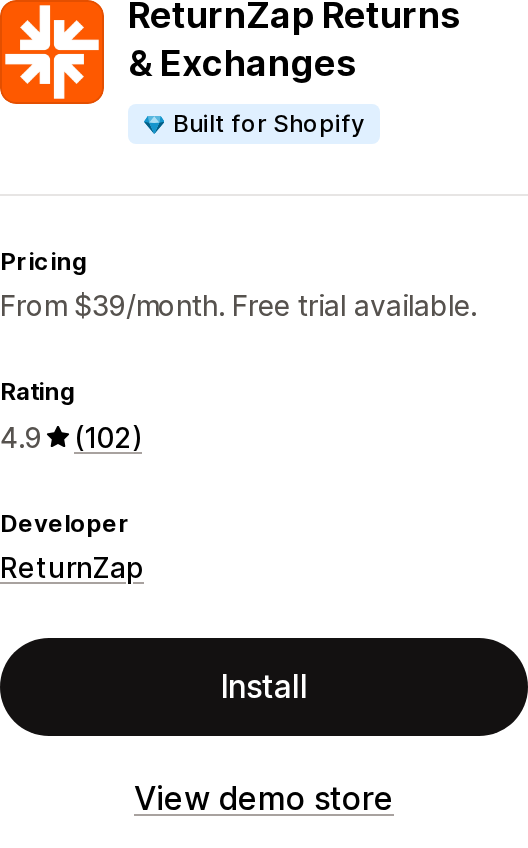
Built for Shopify, 4.9 from 102 reviews — the highest rating in the set on the smallest corpus of the main group, which cuts both ways. Pro is $39/month and Advanced $69/month, both based on 50 returns, with a 14-day trial and no free plan.
It documents all three sourcing paths in one place: Shipping by ReturnZap with "coverage in the US, Canada, UK, Australia, and Europe"; EasyPost, Sendcloud, Shippo and ShipStation as aggregators; and direct carrier accounts, where "customers on the ReturnZap Advanced plan and above can directly connect existing carrier accounts to ReturnZap, without having to go through an integration platform." The gate is on the listing in plain sight: international labels are an Advanced feature.
AfterShip Returns & Exchanges
Source: Shopify App Store listing — captured September 3, 2026
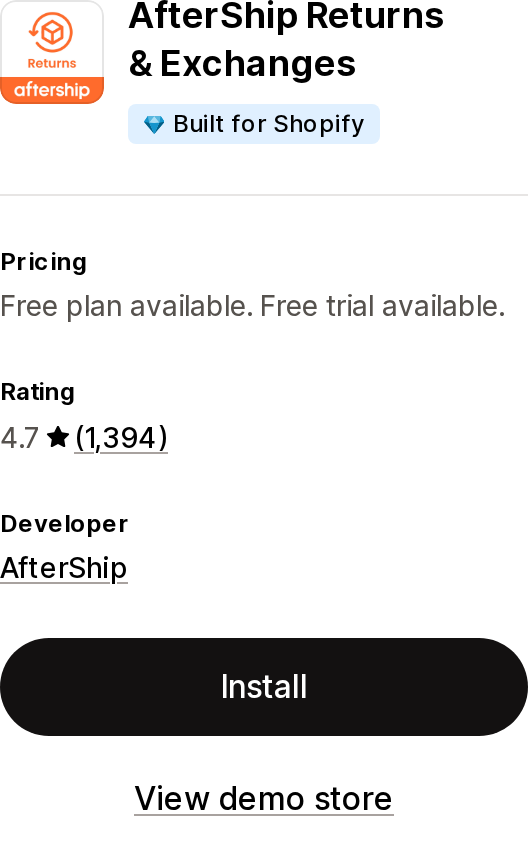
Built for Shopify, 4.7 from 1,394 reviews, the largest corpus in the category. Essentials is $19/month with 20 returns and $0.50 per extra; Premium $119/month with 100 returns and $1.00 per extra. Return Care, the free tier, is shopper-funded revenue share, not a quota-based free plan.
International labels come from Easyship, resold inside the app, with a finite origin list: "United States, Canada, United Kingdom, Germany, France, Belgium, Netherlands, Australia, New Zealand, Singapore, and Hong Kong." The failure mode is stated without hedging: "If your origin country isn't supported by Easyship and you don't have a connected local carrier account, AfterShip Returns cannot generate return labels from that region at this time." And for cost control: "currently, merchants cannot view the billed amount for individual return shipments."
CWILL Returns & Exchanges
Source: Shopify App Store listing — captured September 3, 2026
You may know this app as ParcelPanel Returns & Exchanges. It is now CWILL Returns & Exchanges by CWILL INC, at the unchanged slug. Built for Shopify, 4.9 from 457 reviews — though several recent five-star reviews come from merchants who had used it for a matter of hours.
Its free plan is the most generous label-inclusive free tier here: 6 returns a month, including return labels. Essential is $29/month for 50 returns and Professional $99 for 200, with a flat $0.45 overage on every paid tier and 21 shopper languages. The gap is documentation: unlimited carrier connection is a Professional feature, the ceiling below that is not stated, and no supported-origin-country list appears on any first-party page.
Return Prime:Return & Exchange
4.8 from 723 reviews, and the most granular per-return model in the set: Start is free to install with 5 free return requests at $0.49 per additional, Grow is $19.99/month for 60, Thrive AI $79.99 for 180, Scale $149.99 for 450 or more. The free tier includes an EU-compliant withdrawal button.
Read the overage column, because it inverts: Thrive AI charges $0.79 per additional request while the tiers on either side charge $0.49. International capability is carrier-count-gated rather than geography-gated — two carriers on free, unlimited on Scale — with customs documents as a listing feature tag, and no supported-country list or first-party network stated.
Redo
Source: Shopify App Store listing — captured September 3, 2026
5.0 from 698 reviews. The listing prices Returns at free and Fulfillment at $99/month, but neither is the returns denominator: Redo's help centre describes Managed Returns as "a bundled, per-item pricing model," usage-based and scoped by country, service type and item volume tier, and notes that Redo "does not itemize or discount individual service components if merchants opt not to use certain features." There is no published per-return price.
On duties, Redo makes the strongest claim in the category. Its International Returns page states that "duties and taxes refunded in full — when duties or VAT were collected at checkout, Redo files for the refund on the return leg." That is marketing copy on a product landing page; no corresponding help-centre article was found, and it sits uneasily against Shopify's "aren't always recoverable." Get it in the contract. Note too that its marketing hub list (US, Canada, UK, EU, Australia) is wider than the help centre's Managed Returns origins, "Canada, the US, the UK, and AUS."
Printing a label and clearing customs are two different questions
An international return label is not automatically a duty-free re-import, and that gap is what turns a $30 label into a much larger event. Loop flags packages as return goods but warns customs may still issue duties and taxes even with correct paperwork. ReturnGO's reverse labels may not be classified as returned merchandise at all. ReturnZap markets duty-free re-import and returned goods relief, which is about the return leg rather than the original order. Return Prime, AfterShip and CWILL state no classification behaviour on any page reviewed — "not stated," not "no."
The most precise disclosure comes from an eighth app, Rich Returns & Exchanges: "ShipStation does not let us specify the contents of the shipment as 'Returned Goods' but merely as regular 'merchandise' which might affect customs charges." On recovering duty from the original order, six of the seven apps compared here make no claim at all.
What a return costs once you read the denominator
Every app here passes label cost through separately, and none publish an international rate card — on a transatlantic lane, the label is usually the larger number.
| App | Billing denominator | Overage per return |
|---|---|---|
| Loop Returns & Exchanges | Flat monthly, no published quota; free tier covers US and Canada domestic labels | Not published |
| ReturnGO Returns & Exchanges | Per return with quota; no free plan | $1.25, or $0.90 on Pro |
| ReturnZap Returns & Exchanges | Per return, volume-banded; no free plan | $1.00 down to $0.50 |
| Return Prime:Return & Exchange | Per return request; 5 free requests | $0.49, but $0.79 on Thrive AI |
| AfterShip Returns & Exchanges | Per return with quota, or shopper-funded revenue share | $0.50, or $1.00 on Premium |
| CWILL Returns & Exchanges | Per return with quota; 6 free returns including labels | $0.45 flat on every paid tier |
| Redo | Bundled per-item, usage-based, quote-only | Not published |
At 60 international returns a month the software line looks like this — verified on the English App Store listings on September 3, 2026, all excluding labels:
- Return Prime Grow — $19.99, 60 included, but only two carriers
- CWILL Essential — $29 plus 10 × $0.45 = $33.50
- AfterShip Essentials — $19 plus 40 × $0.50 = $39
- ReturnZap Advanced — $69, the cheapest tier that unlocks international labels
- ReturnGO Premium — $147, with 50 of the 110 returns unused
- Loop Essential — $155
- Redo — quote required
Two of those overage rates invert going up the ladder: AfterShip Premium charges double Essentials, and Return Prime's Thrive AI charges more than the tiers on either side. Near a quota boundary, the cheaper-looking plan is often the cheaper plan.
In-country hubs are real, and more than one vendor offers them
If a transatlantic parcel costs more than the item's margin, the label source is the wrong thing to optimise. What you want is a local drop-off address, local inspection and consolidated batch shipping — and three vendors offer some version of it, through three different commercial structures. Redo runs shared hubs described as being in the US, Canada, UK, EU and Australia, with grading before the refund fires. ReturnZap markets in-market return centers offering "return inspection, consolidation, and shipment" across the US, Canada, EU, United Kingdom and ANZ. Loop reaches consolidated service through Pro Carrier, which lists "consolidated & direct return solutions across the EU, UK, US, and AUS" and duty drawback automation. The other four document routing to multiple return destinations, which is address selection rather than a hub network.
Decide in this order
- All returns US-domestic? Nothing to buy. Shopify does self-serve returns, rules, fees and USPS/FedEx/UPS labels natively.
- A few international returns a month? Still nothing. Upload a return label with a carrier-bought label is a legitimate operating model.
- On Managed Markets? You need an app more than most — post-fulfillment duties, customs fees and VAT are explicitly not refunded.
- Cheapest published path to international labels? ReturnZap Advanced, $69/month, which also takes your own DHL, UPS, FedEx or Royal Mail contract.
- Free tier that still prints labels, plus 21 shopper languages? CWILL Returns & Exchanges — confirm your lane with support first.
- Per-return pricing with no monthly floor? Return Prime, watching the Thrive AI overage inversion.
- Widest documented lane coverage? Loop, provided every variant carries HS code, country of origin, weight and SKU.
- Freight cost is the problem, not label availability? Hubs: Redo, ReturnZap, or Loop plus Pro Carrier.
- Duty recovery decides it? Get it in writing. Shopify's position is that remitted import taxes "aren't always recoverable."
Sources
- Shopify Help Center: Return labels, Creating returns, Return rules, Refunding orders, Duties and import taxes, Managed Markets overview, Managed Markets fulfillment
- shopify.dev: View and refund duties
- Loop: International Cross-Border, International Lite, Pro Carrier integration
- ReturnGO: Ship by ReturnGO
- ReturnZap: How return labels work, Global Returns
- AfterShip: Easyship integration FAQs
- Rich Returns: Customs declaration for international shipments
- Redo: Managed Returns cross-border FAQs, International Returns
- Shopify App Store listings, pricing tabs and public reviews for every app named, retrieved September 3, 2026
Shopify Flow adds and removes product tags for free on every paid plan, but its Get product data action returns at most 100 products per run, so backfilling an existing catalog becomes a scheduled loop. Flow also has no generic Product updated trigger, which means it structurally cannot re-tag a product after you edit its type, vendor, or price. Shopify Magic suggests a product category and fills category metafields, but product tag generation is not on its published feature list. The six apps compared here meter completely different units: Leap Auto Tags counts every tag added and every tag removed as one credit against 2,000 per month at $8, FilterTag meters 500 to 50,000 generated tags per month at $9 to $59, TAGit AI works out to 3 to 9 cents per generated tag, and Helium charges $9.99 one-time per 100 products. Mechanic and Matrixify charge flat fees of $16 to $199 and $20 to $200 with no per-tag metering at all. Check the denominator before you check the price. Researched September 3, 2026.