
What you will learn
On this pageContentsCloseOpen
You want "Arrives Sep 8–12" under the Add to cart button. You search for how to do it, and the first ten results agree: Shopify has no native estimated delivery date, so install one of these apps.
That premise is wrong, and being wrong about it costs money in both directions. Some merchants pay for an app that duplicates a free setting they never switched on. Others switch the setting on, see nothing appear on the product page, and assume it's broken.
What Shopify actually ships
Go to Settings → Shipping and delivery → Estimated delivery dates. There are three modes.
Automated produces a single date — Estimated delivery Mon, Jun 30. It needs Basic plan or higher, an active fulfillment location in an eligible country, and at least one already-fulfilled domestic order.
Manual produces a range — Wednesday, October 27 – Thursday, October 28 — and is available on every plan. It calculates from your configured fulfillment time plus the transit time attached to the shipping rate.
Off shows only transit times, like Standard (3 to 4 business days).
The two calculated modes can run together. If an order isn't eligible for an automated date, manual dates act as the fallback.
So the feature exists. The problem is where it renders. In Shopify's own words, these dates appear "at checkout, in accelerated checkouts such as Shop Pay, in order confirmation emails, and on the Thank You and Order Details pages after checkout."
Every one of those is at or after checkout. Nothing in this setting touches the product page or the cart.
The one native product-page path, and why you probably can't use it
Shop Promise is the exception. It "displays delivery dates and badges on product pages, during checkout, and in the Shop app."
It is also invite-only. Shopify describes it as recognizing "the top 1% of shippers on Shopify," reassessed every 30 days. To qualify you need Shop Pay active, a live Shopify Payments account, the Shop sales channel installed, and an active US fulfillment location — and it covers only US domestic orders estimated to arrive within five calendar days. Pre-orders and zero-inventory products are excluded. Placement requires either dropping <div class="delivery-promise__promise-container"></div> into your product form or adding a Custom Liquid block, and accelerated checkout buttons must be active.
One nuance almost nobody reports: Shopify's eligibility page says that if a store stops qualifying, "you'll still be able to display estimated delivery dates on your product pages and during checkout for orders delivered within 5 days, but they won't include the badge." So the product-page module isn't strictly badge-locked. It is, however, locked behind having been admitted in the first place.
Shop Promise also carries a real guarantee. If the first delivery attempt lands later than promised, the customer may claim $5.00 USD in Shop Cash. That is Shopify's money, not yours, which is why the eligibility bar is where it is.
The native limits that actually push people to apps
Placement is the headline, but these are the ones that surprise merchants after they've already turned the feature on.
The cutoff is 12 pm and you cannot change it. Shopify: "The business day cutoff time is 12 pm in the local timezone of the shipping origin." Business days are Monday to Friday. If your warehouse cuts off at 2 pm or 4 pm, native manual dates will systematically under-promise every afternoon order.
Automated dates only fire on short trips. The prediction must land within 5 days for US orders (4 for European ones). Furniture, made-to-order, and long-lead-time catalogs get nothing.
Cross-region orders never get an automated date. US to US works. Europe to Europe works. US to France does not.
Your rate type can disqualify you silently. Delivery dates don't work with rates provided by third-party apps, and don't work with negotiated FedEx-calculated rates. Custom flat rates can carry a delivery description but not a transit time, so they can never produce a calculated date.
One bad rate poisons the rest. Shopify: "If your checkout displays a mix of eligible and ineligible shipping rates, then delivery dates aren't displayed for your eligible rates." A single misconfigured rate silently removes dates from every other option.
Out of stock means no date. Manual dates require inventory above zero — which is exactly backwards from what merchants want, since backordered items are where a lead-time estimate matters most.
There is also no merchant-configurable holiday calendar, no blackout days, and no per-product, per-collection, or per-vendor override. Shopify's manual-delivery-dates worked example does show statutory holidays being skipped — "Holidays don't count as fulfillment time" — so the calculation isn't holiday-blind; you just can't add your own closures to it. Automated dates additionally exclude digital products, app-provided pre-orders, subscriptions, and try-before-you-buy, and Shopify documents separately that delivery dates don't support third-party dropshipping apps.
Building it yourself
It is possible, and worth pricing honestly against a $5/month app.
Store lead time in a product or variant metafield. Render the estimate in the product template — but Liquid's "now" evaluates server-side and is aggressively cached on the Online Store, so a cutoff-aware calculation has to run client-side in JavaScript. Hand-maintain an array of the eleven US federal holidays plus your own warehouse blackout dates. Re-run the calculation on every variant change, which is a documented failure mode that has bitten more than one commercial app in this category. Then repeat the whole thing for the cart template, with a different DOM and different re-render triggers.
And it still can't reach the checkout steps without Shopify Plus.
Call it one to two developer days plus permanent maintenance of the holiday table.
Five apps, priced and checked
All figures from the en-US App Store listings on September 2, 2026. Ratings and review counts in this category fluctuate noticeably even within a single day — treat them as approximate and re-check before you commit.
| Estimated Delivery Date ‑ ETA | S Estimated Delivery Date Plus | Essent Estimated Delivery Date | C‑EDD: Estimated Delivery Date | NS Estimated Delivery Date | |
|---|---|---|---|---|---|
| Developer | SetuBridge | Synctrack | Essential Apps | Coder | NestScale |
| Built for Shopify | No | Yes | Yes | No | Yes |
| Rating (reviews) | 4.9 (468) | 4.9 (404) | 5.0 (922) | 4.9 (337) | 4.8 (84) |
| Free plan | 100 ETA views | 1 estimate rule | Entire app | 100 products, 1 holiday | 100 products, product page only |
| Free trial | 7-day | 3-day | n/a | None | 3-day |
| Entry paid tier | $6.99/month | $4.99/month | — | $4.98/month | $7.99/month |
| Top tier | $19.99/month | $29.99/month | — | $8.98/month | $34.99/month + overage |
| What meters it | ETA views, then rule count | Rule count | — | Product/country/holiday quotas | Products + tracked orders |
| Cut-off time | Yes | Yes | Claimed in copy, absent from feature list | Yes | Growth tier and up |
| Holidays | Yes | Yes | Block dates | Quota-metered | Yes, including free tier |
| Visitor-local timezone | Undocumented | Undocumented | Undocumented | Stated explicitly | Automatic, including free tier |
| Post-purchase tracking | Partial | No | No | No | 2,800+ carriers |
| Requests order access | Reads orders | Edits orders | None requested | Not stated | Not stated |
Every app in this table claims checkout display somewhere in its copy. Treat those claims carefully — see the Plus section below.
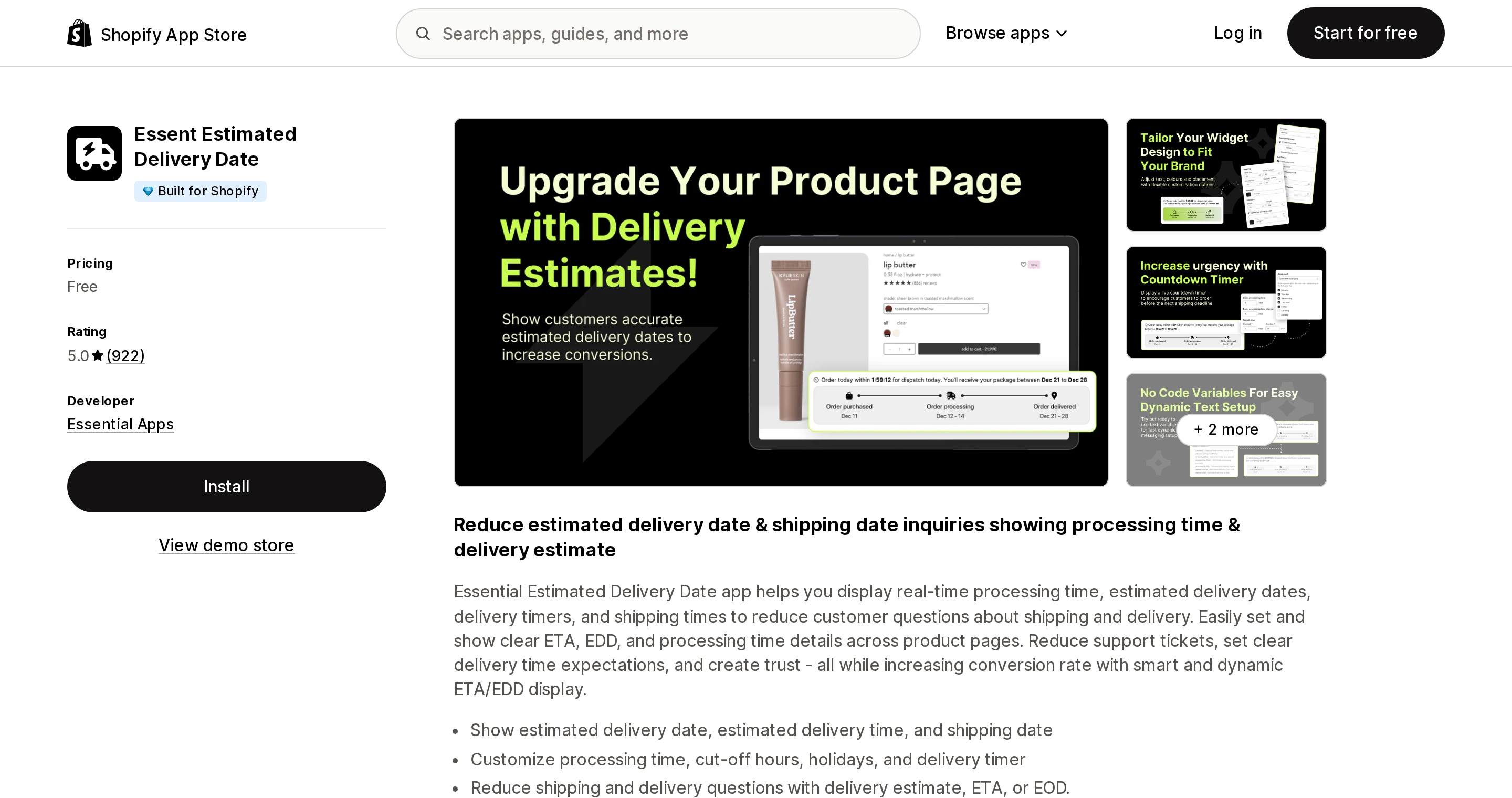
Essent Estimated Delivery Date
Source: Shopify App Store (Essent Estimated Delivery Date), retrieved September 2, 2026
The highest-rated app in the category is free. 5.0 across roughly 922 reviews, with a single one-star and a single two-star review in the entire corpus, and the one-star has no written body. It carries Built for Shopify. Its pricing section on the listing is literally empty — the header just says Free.
It also has the narrowest data scopes here. It views your theme, edits products and discounts, and views locales, Markets settings, and inventory. It does not request order access at all, which distinguishes it sharply from Synctrack's app, which edits orders, theme, and Markets settings.
Two honest caveats. Its structured feature taxonomy is the thinnest in the set — under delivery options it lists only block dates and countdown timers, while the marketing copy claims cut-off hours. And its placement claims center on product pages; cart and checkout placement is not asserted the way the other apps assert it. Two merchant requests in the reviews — multiple widgets on one page, and widget duplication — were acknowledged by the vendor as not currently available.
The app launched in June 2025 and has no paid tier. Nobody has explained how that stays true, so don't build a five-year plan around the price.
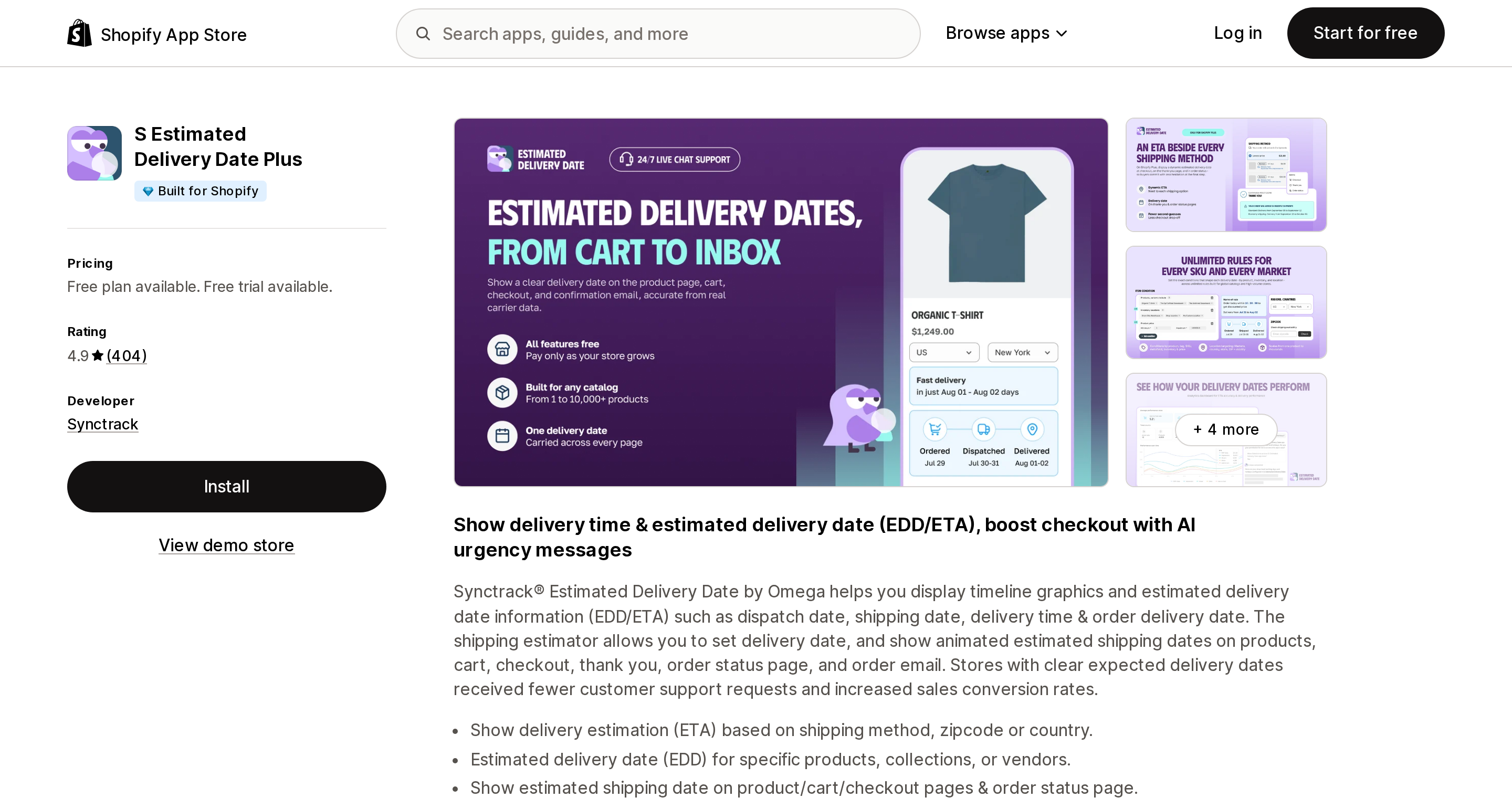
S Estimated Delivery Date Plus
Source: Shopify App Store (S Estimated Delivery Date Plus), retrieved September 2, 2026
Formerly branded Omega, and still signing support replies as "Omega Team." Launched in 2018, the longest track record here, Built for Shopify, with animated timeline graphics showing dispatch date to shipping date to delivery date.
Its plan segmentation is the most honest in the category, and it teaches the whole topic in one line. STANDARD at $4.99/month gives you "Show Static EDD in Cart, Checkout, Email." PLUS at $29.99/month gives you "Checkout Extension with Dynamic ETA." Static text versus an address-aware calculation — that gap is what the Plus wall actually costs.
The free tier is one estimate rule, which one reviewer called useless, fairly. More useful is a US merchant's April 2025 report: "It won't let you set different processing and delivery times for different types of products. This option in the app does not work well if you have more than 25 products in your store." That is one review, from a merchant six days into the app, and Synctrack replied disputing it — but it's the only published account of where the rule model starts to strain, so it's worth testing against your own catalog during the trial. Another US merchant reported the widget rendering three duplicate boxes reading "Shipping to Afghanistan" on every product page after launch, and that disabling the app in the theme didn't remove it — only uninstalling did.
The developer replies are fast and detailed throughout, which counts for something. The trial is three days, the shortest here.
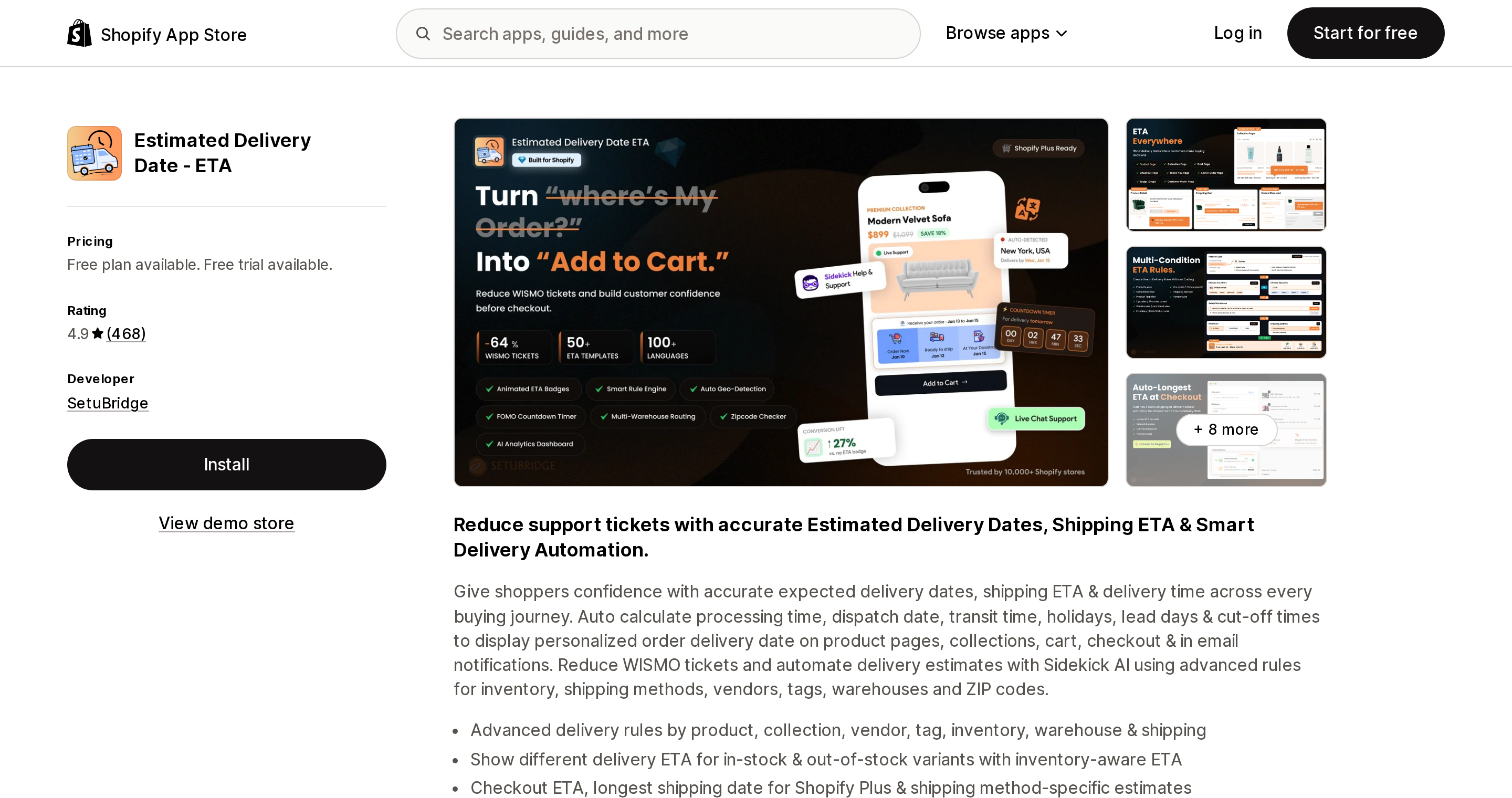
Estimated Delivery Date ‑ ETA
Source: Shopify App Store (Estimated Delivery Date ‑ ETA), retrieved September 2, 2026
The deepest rule engine at this price point. Rules by product, collection, vendor, tag, inventory state, warehouse, shipping method, ZIP code, country, and state — plus cutoff times, preparation time, and block dates. Inventory-aware estimates mean a different date for in-stock and out-of-stock variants, which is precisely the case Shopify's native feature refuses to handle.
Rule count is the meter: 15 rules on STARTUP at $6.99/month, 50 on GROWTH at $14.99, 300 on PREMIUM at $19.99. A store with many collections can exhaust GROWTH.
Two things to know before installing. The checkout features on PREMIUM are tagged in the listing itself as Checkout shows longest ETA #ShopifyPlus and Checkout shipping ETA #ShopifyPlus — the vendor is telling you that tier needs Plus. And the listed carrier integrations are India-centric (Delhivery, Xpressbees, DTDC, Shiprocket, Bluedart, Ekart); no USPS, UPS, or FedEx integration is listed. The estimate here is rule-based, not carrier-API-based.
Reviews show recurring theme-compatibility friction, and one merchant reported that enabling the app publishes its default settings live immediately, so shoppers briefly see wrong data before you've configured anything. The current listing shows no Built for Shopify badge.
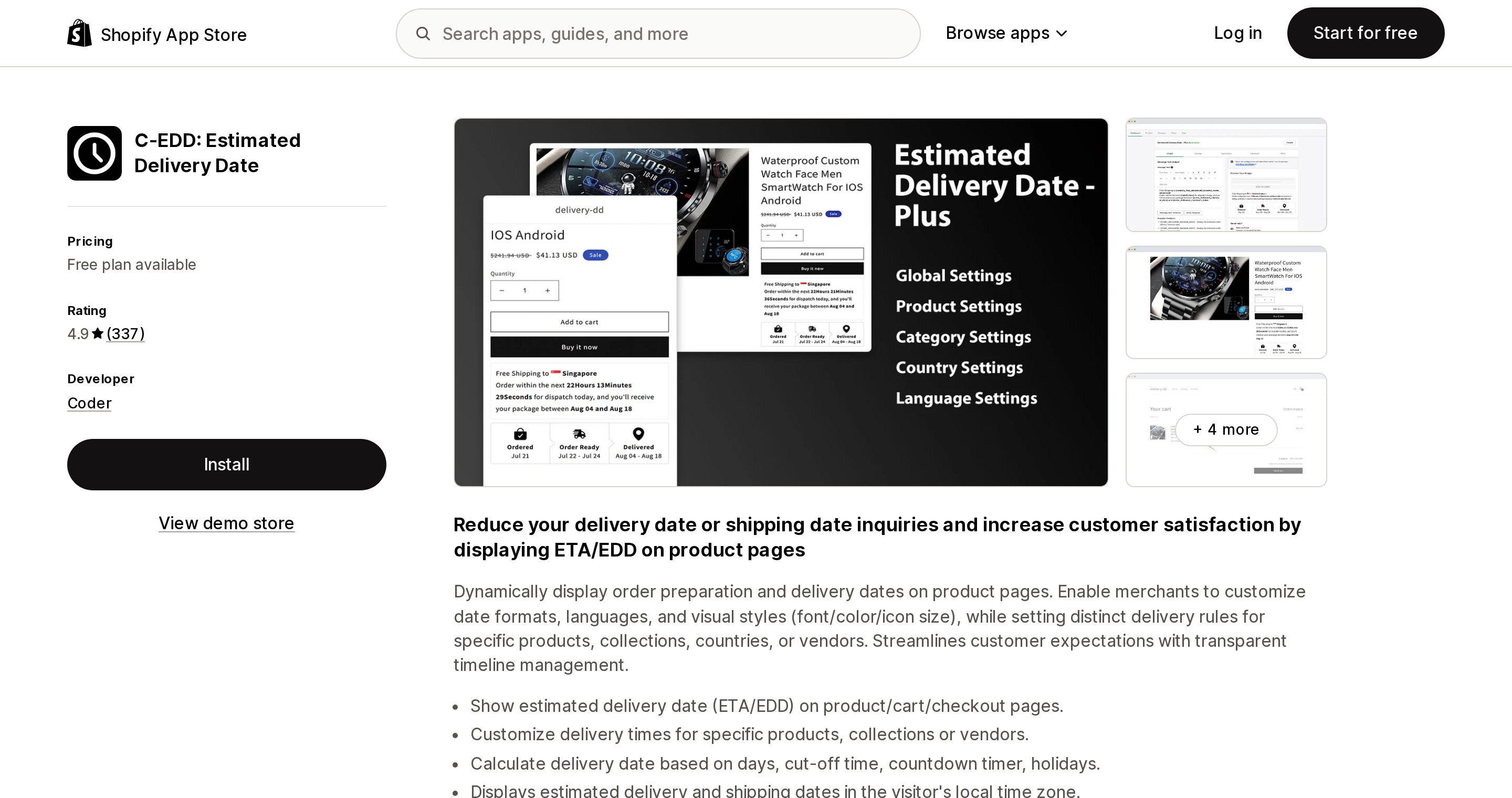
C‑EDD: Estimated Delivery Date
Source: Shopify App Store (C‑EDD: Estimated Delivery Date), retrieved September 2, 2026
The cheapest unlimited tier in the category: $8.98/month for unlimited products, categories, countries, languages, and holidays. It is also the only app here that explicitly states it "displays estimated delivery and shipping dates in the visitor's local time zone," and the only one that explicitly states Online Store 2.0 compatibility.
The free tier is a trap for a US merchant, though: one holiday. There are eleven federal holidays. And there is no free trial on either paid plan, which is unique in this set — you pay to evaluate.
The most important review here comes from a merchant of over a year (Criemos, January 2026) who configured business-day counting to exclude Saturdays and Sundays and reports that the app "muchas veces lo calcula de corrido" — frequently counts straight through the weekend anyway — and sometimes leaves no date on the order at all. Described as intermittent and unresolved. A long-tenure merchant reporting a core-logic defect carries much more weight than an install-day complaint, and it should temper the price advantage.
NS Estimated Delivery Date
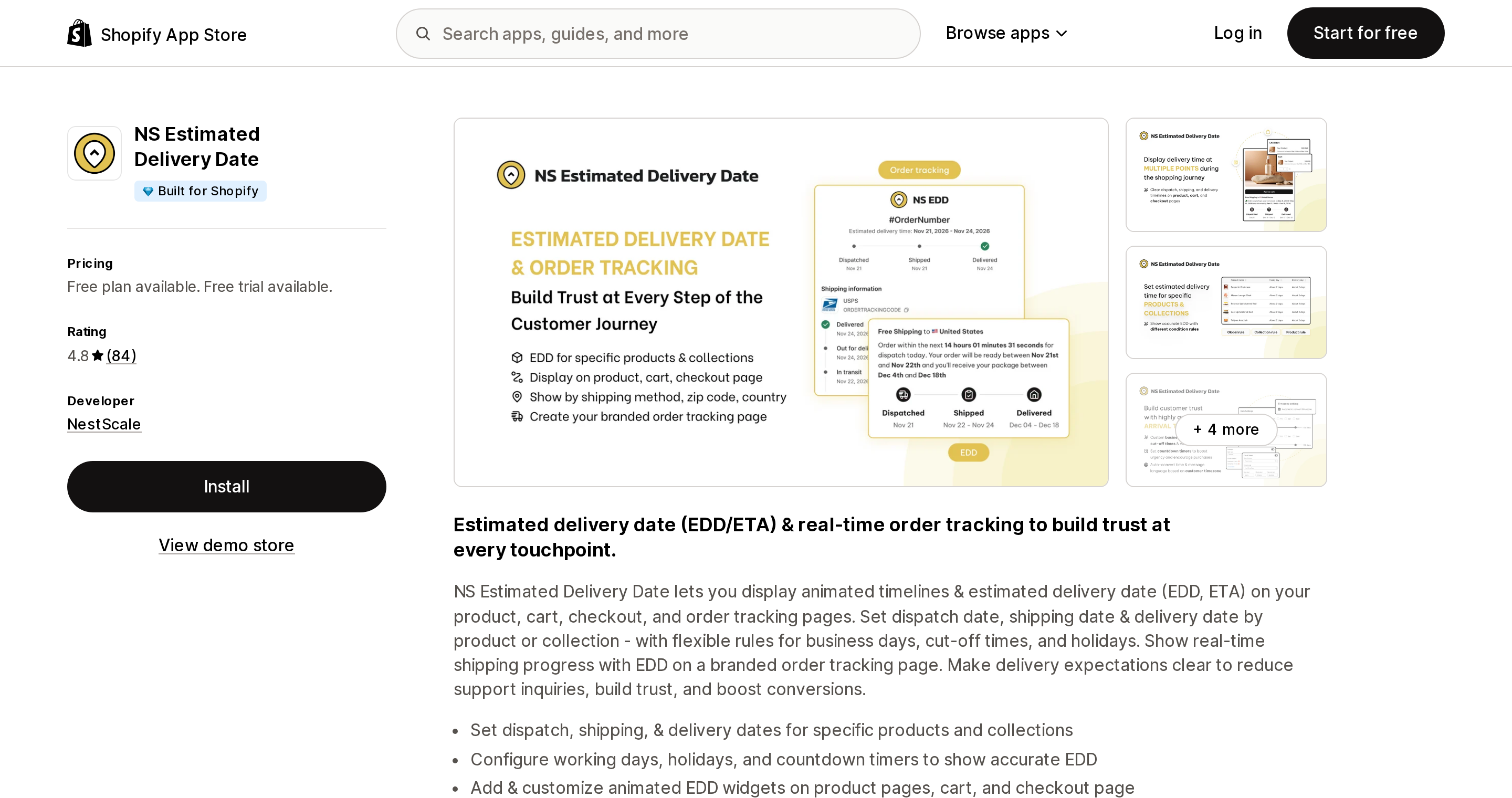
Source: Shopify App Store (NS Estimated Delivery Date), retrieved September 2, 2026
The only app here that closes the loop: a pre-purchase estimate plus a branded post-purchase tracking page across 2,800+ carriers. If your actual goal is fewer "where is my order" tickets rather than a widget for its own sake, that combination does more than either half alone. Automatic timezone conversion is documented and available even on the free tier, which is the strongest timezone story in the set.
The pricing needs arithmetic. Growth is $7.99/month and includes 200 tracked orders, then charges "$0.04 per extra tracked order." A store doing 2,000 tracked orders a month pays $7.99 plus 1,800 × $0.04, or roughly $79.99/month. Professional at $34.99 includes 1,000 orders at $0.035 beyond that. The headline price is honest only under about 200 orders a month.
The free tier is product-page only and capped at 100 products. With 84 reviews it has the smallest base here — three one-star reviews is too few to establish any pattern, and this article isn't claiming a clean record, only a thin one.
The Plus wall, stated plainly
Checkout UI extensions that render on the information, shipping, and payment steps are Shopify Plus only — shopify.dev states it plainly. Extensions targeting the Thank you and Order status pages are not behind that gate.
So if what you want is an app-controlled, address-aware estimate inside the checkout steps, that's a plan decision, not an app decision. Several apps in the table claim "checkout" without distinguishing which surface they mean, and at least one advertises checkout display on a $4.99 tier in a way that appears to sit uneasily with Shopify's rule. Ask the vendor which extension target they use before you buy on that basis.
Non-Plus merchants have a better answer available anyway: put the app widget on the product page and cart, use the Thank you and Order status pages for post-purchase, and let Shopify's own native delivery dates handle the checkout step. That part is free, and you already have it.
The FTC angle nobody covers
Shopify's own Shop Promise activation documentation links merchants to the FTC's Mail, Internet, or Telephone Order Merchandise Rule. It's worth understanding why.
The Rule governs shipment, not arrival. If you state a shipment time you need a reasonable basis for it; if you state none, the FTC's position is that "you must have a reasonable basis for believing that you can ship within 30 days." The clock starts when you receive a properly completed order — correct payment plus everything you need to fill it — not when the payment clears.
That distinction maps directly onto your widget copy. "Arrives Sep 8–12" is an arrival estimate. It sits under general deception standards: don't say it if you don't believe it. "Ships in 1 business day" is a shipment representation. That phrasing pulls you into the Rule's machinery — if you can't meet it, you have to seek the customer's consent to the delay through a delay option notice, and if you can't obtain consent you must promptly refund without being asked. The FTC also treats updated shipment information given online as superseding what your advertising said, which means the widget text is itself a representation you have to stand behind.
Practical takeaway: prefer a hedged arrival range over an unqualified single-date promise, and keep any shipment claim separately substantiated. This is a summary of published FTC guidance, not legal advice — Shopify's own documentation tells merchants to consult their own counsel, and so does this article.
Choosing
You only need a date at checkout and after, ship on native rates, and cut off at or before 12 pm → turn on Estimated delivery dates and install nothing.
You have Shop Pay, Shopify Payments, the Shop channel, a US fulfillment location, and you ship fast → check Sales channels → Shop → Promise for an activation notice first. It's the only free native product-page date.
Your rates come from a third-party app, or negotiated FedEx, or you dropship, or your catalog is backordered or subscription-based → native is structurally unavailable. Skip straight to an app.
Most US SMBs wanting a product-page estimate → start with Essent Estimated Delivery Date. Free, Built for Shopify, cleanest review profile in the category, no order access. Verify cart and checkout placement yourself if you need them.
You need cart, checkout, and email coverage on a budget → S Estimated Delivery Date Plus at $4.99–$9.99, with the 25-product scaling report in mind.
You need vendor, warehouse, tag, or inventory-state rules → Estimated Delivery Date ‑ ETA at $14.99–$19.99.
You want the estimate and post-purchase tracking in one app, under ~200 orders a month → NS Estimated Delivery Date at $7.99. Run the overage math first.
You want unlimited rules under $9 and care most about timezone accuracy → C‑EDD at $8.98, with the business-day calculation report taken seriously and no trial to fall back on.
One last note on stale advice: EDDer by Channelwill still appears in 2025-vintage roundups. Its listing now reads "This app is not currently available on the Shopify App Store." Check the listing before you trust any list, including this one, after about 90 days.
This article covers displaying a predicted arrival date before purchase. Letting the customer pick a delivery date or time slot at checkout is a different problem with different apps, and is covered separately.
Sources
- Shopify Help Center — Delivery expectations overview
- Shopify Help Center — Shop Promise
- Shopify Help Center — Shop Promise eligibility
- Shopify Help Center — Activate Shop Promise
- shopify.dev — Checkout UI extensions
- shopify.dev — Delivery customizations
- FTC — Business Guide to the Mail, Internet, or Telephone Order Merchandise Rule
- Shopify App Store listings and review pages for all five apps, en-US locale, retrieved September 2, 2026
Shopify Flow adds and removes product tags for free on every paid plan, but its Get product data action returns at most 100 products per run, so backfilling an existing catalog becomes a scheduled loop. Flow also has no generic Product updated trigger, which means it structurally cannot re-tag a product after you edit its type, vendor, or price. Shopify Magic suggests a product category and fills category metafields, but product tag generation is not on its published feature list. The six apps compared here meter completely different units: Leap Auto Tags counts every tag added and every tag removed as one credit against 2,000 per month at $8, FilterTag meters 500 to 50,000 generated tags per month at $9 to $59, TAGit AI works out to 3 to 9 cents per generated tag, and Helium charges $9.99 one-time per 100 products. Mechanic and Matrixify charge flat fees of $16 to $199 and $20 to $200 with no per-tag metering at all. Check the denominator before you check the price. Researched September 3, 2026.