
What you will learn
On this pageContentsCloseOpen
Open the Shopify admin, create a discount, and look at who can use it. The eligibility options are All customers, Specific customers, Customer segments, and Markets. Every one is a query against data your store already holds — order history, tags, location. None can tell you whether the person on the other end is actually active-duty military, a veteran, a nurse, a teacher, or an enrolled student.
That gap has a consequence. A military discount built with native tools is a code, and a code is a string. Limit to one per customer tracks an email address or phone number, which stops one identity from redeeming twice but proves nothing about affiliation. A second inbox is a second entitlement.
So the question is not which verification app is best. It is which app checks the communities you care about, at a cost structure you can absorb, and delivers the discount in a way your storefront can handle. Those three things vary far more than the feature lists suggest.
Below: where Shopify stops, the three pricing models with identical cost math applied to each, the code-versus-tag split, and seven real App Store listings compared. Research date: September 2, 2026. All prices in USD, confirmed on that date.
The short version
Shopify is the discount engine. The app is the verification layer. Creating the discount is native. Proving who deserves it is not, and Shopify's own documentation points merchants to apps once eligibility goes beyond what the admin offers.
Pricing splits three ways, and the cheapest option flips with volume. Commission models get expensive as order value rises; per-verification models get expensive as volume rises.
Delivery splits two ways. Code-issuing apps hand the shopper a single-use code to type. Customer-tag apps set a tag so an automatic discount fires — which usually means the shopper needs a store account.
Military and student are usually not the same app. GOVX ID cannot verify students at all. And one listing here, SheerID, is documented as available to existing SheerID customers only rather than open to the public.
What Shopify does natively, and where it stops
Native discounts cover amount off products, amount off orders, Buy X get Y, and free shipping, as codes or automatic discounts, in percentages or fixed amounts, scoped to products or collections and gated on minimum purchase or quantity.
Eligibility is where it ends. All four options are store-internal. Customer segments are dynamic ShopifyQL lists built from your own data, so a segment can express "customers who bought twice in Texas" but never "customers who serve in the Army." Something has to put that fact into your store first.
Other native limits worth knowing before designing around this:
- A store can create 20,000,000 discount codes cumulatively, and Shopify states that "Third-party apps and custom solutions cannot bypass or increase this limit."
- A single code can name at most 100 specific customers, products, or variants — which rules out adding every verified customer to one code.
- Automatic discounts on Shopify POS require POS Pro; on a POS Lite location they do not appear at checkout.
- Discount codes do not apply on the post-purchase page.
- B2B catalogs are assigned to companies and company locations — a wholesale mechanism, not a consumer status gate. Basic, Grow, and Advanced allow three active catalogs; Plus is unlimited.
One native path does work. If you already know who qualifies because a human reviewed IDs, tag those customers, build a segment on the tag, and set that segment as eligibility. It costs nothing and needs no app. It just does not scale, because the human review does not.
Pricing model 1: free verification, optional marketplace commission
GOVX ID Exclusive Discounts
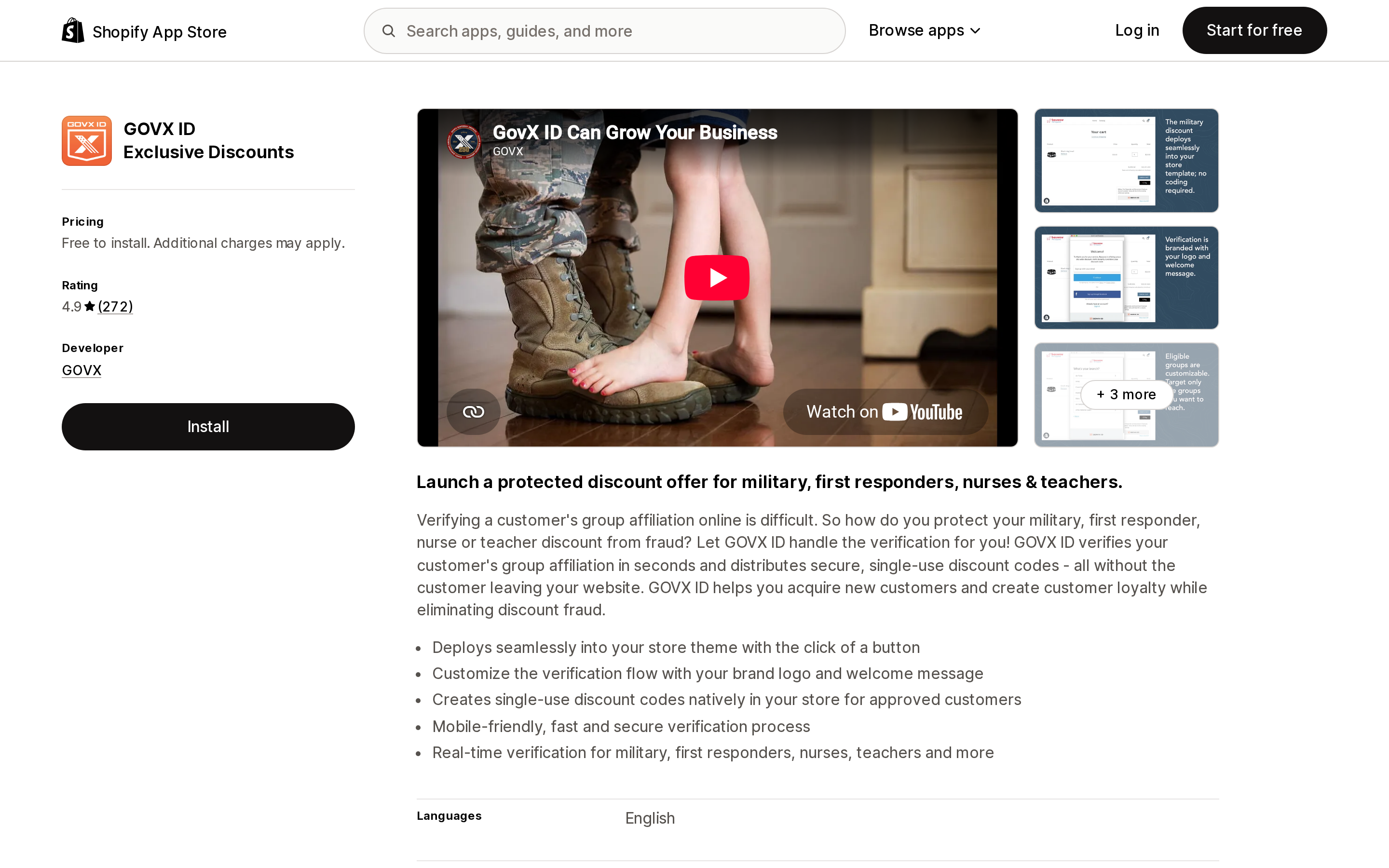
Source: Shopify App Store listing, captured September 3, 2026.
GOVX ID Exclusive Discounts is Free to install, and no per-verification charge appears in its public documentation. It rates 4.9 out of 5 across 272 reviews — the largest review base here — with exactly one 1-star review on file.
It verifies seven groups in the United States: Military, Military Families, Law Enforcement, Fire, Medical Services, Government Employees, and Education. Medical Services covers nurses, hospital physicians and PAs, hospital staff, and EMTs. Education means teachers, faculty, and school staff — students are not included.
Delivery is code-issuing. Codes generate in real time, all prefixed GX, and GOVX states that "All codes are single-use, so they cannot be shared." A shopper gets one code per 24 hours, and requesting again while holding an unused code returns the same one. The app manages a Shopify price rule; editing it directly in the admin desynchronizes the app. GOVX ID also supports Shopify POS through QR codes and a GOVX Discount smart grid tile — the only candidate with documented in-store support — while its checkout app block is, per GOVX support, "only available if you are on a Shopify Plus subscription plan." Cart buttons and landing pages work on every plan.
About that "free." Verification genuinely is. The commission lives in a separate, optional program: the GOVX Marketplace, which lists your store on GOVX.com. Listing is free, and a shopper who comes straight to your store costs nothing. Orders originating on GOVX.com carry a 15% sales commission on the post-discount subtotal, and GOVX documents that it "does NOT back out sales commission for refunded or canceled orders." Listing also requires a category minimum discount — 25% for Apparel and Accessories, 30% for Eyewear and for Jewelry and Gifts, 15% for Tech and Electronics.
The arithmetic for apparel: a $100 item at the 25% minimum nets a $75 subtotal, and 15% of that is $11.25, so you recognize $63.75 before COGS and shipping — and a return does not bring the $11.25 back. That may still be sound acquisition cost against a pre-verified audience. It is not the same thing as free.
Pricing model 2: monthly fee plus per-verification
VerifyPass Community ID
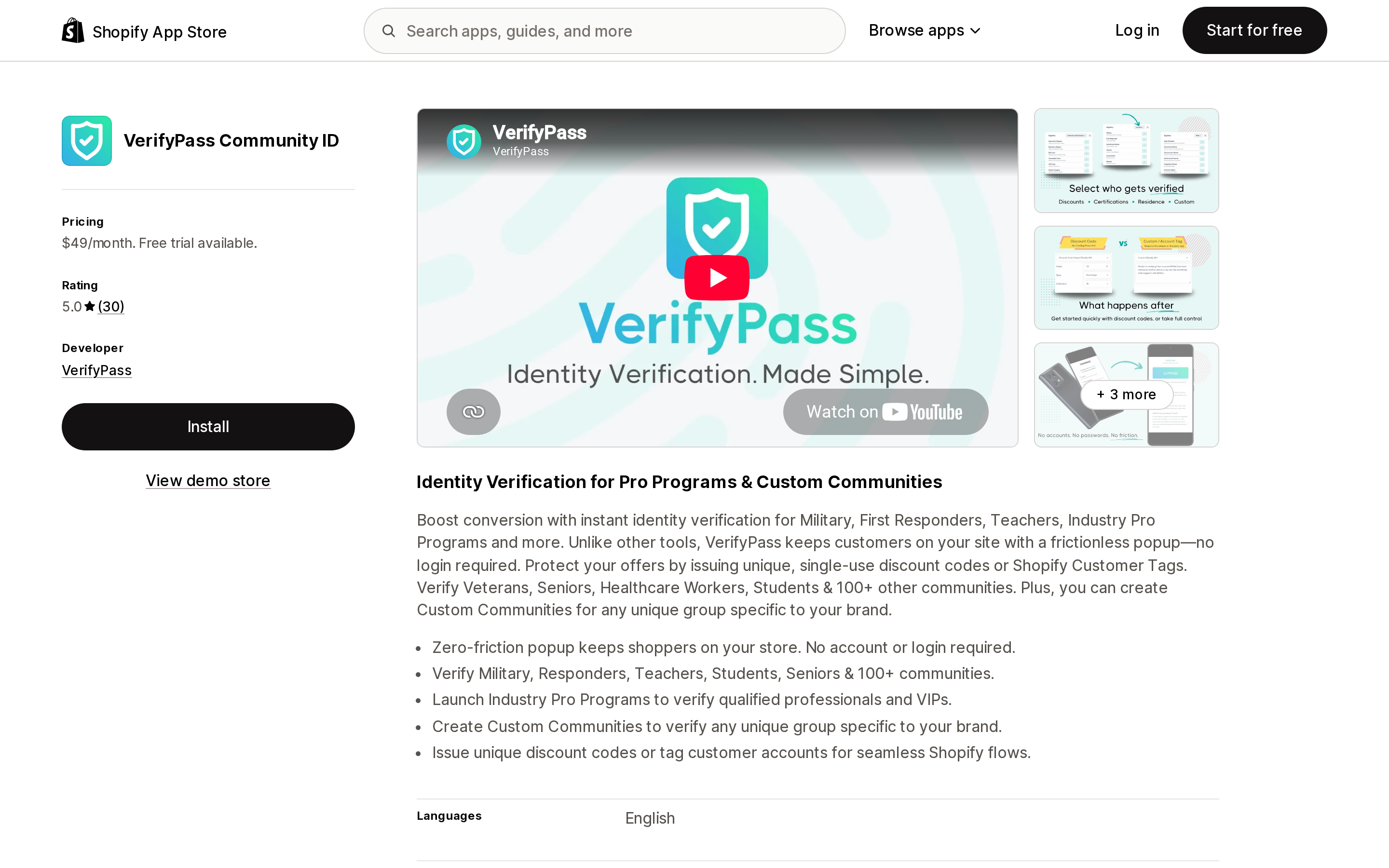
Source: Shopify App Store listing, captured September 3, 2026.
VerifyPass Community ID lives at an App Store URL ending in military-discount, a leftover from an earlier name that is worth knowing before you assume you clicked the wrong listing. One plan, $49 per month, including the first 49 verifications. Beyond that, rates step down by volume band: $0.94 each from 50 to 249, $0.89 from 250 to 999, $0.84 from 1,000 to 4,999, $0.79 above 5,000. The 14-day free trial ends at 14 days or 49 verifications, whichever comes first.
Two billing details favor the merchant: VerifyPass charges only for positive verifications, so failed attempts cost nothing, and there is no contract. One does not: unused verifications do not roll over.
Coverage is the widest of any candidate — military, first responders, healthcare workers, teachers, government, students, seniors 60 and over, government assistance recipients, union members, plus industry categories, occupations, credentials, and residency in the US, UK, Canada, or Australia. Custom Communities let you define your own group for an upfront setup fee whose amount is not published. Verification itself needs no login; a popup keeps the shopper on your store. What happens after verification is the interesting part, covered below.
Two constraints to plan around. One Shopify store equals one VerifyPass account, so a second storefront means a second install and subscription. And the clean 5.0 rests on 30 reviews whose newest entry is dated April 9, 2025 — more than a year stale as of this research.
ID.me Community Verification
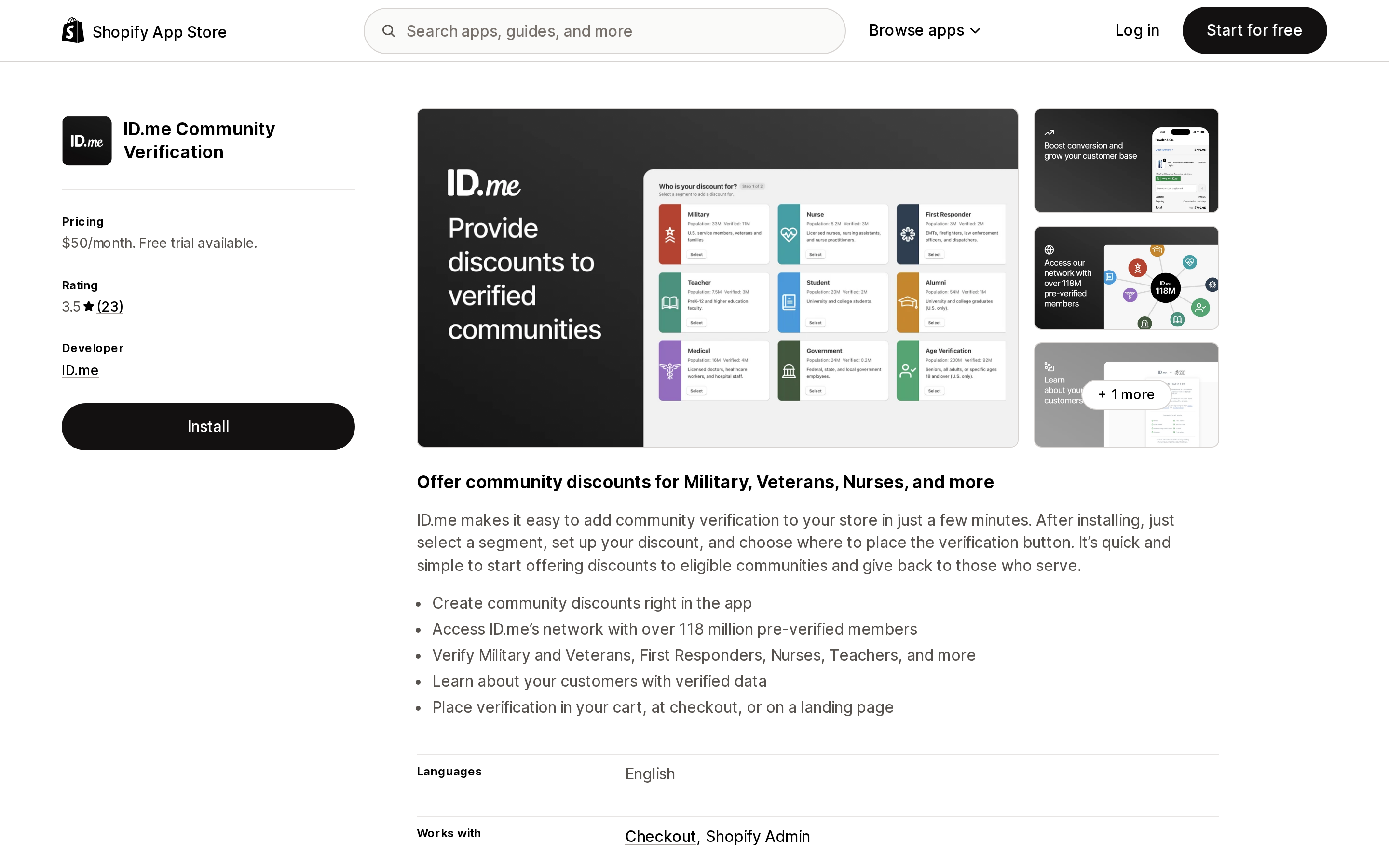
Source: Shopify App Store listing, captured September 3, 2026.
ID.me Community Verification runs one plan, Basic, at $50 per month including 40 verifications, then $1.25 per verification, with a 7-day trial and no free tier. Its pitch is reach: an ID.me network of more than 118 million pre-verified members covering military and veterans, first responders, nurses, and teachers, placeable in the cart, at checkout, or on a landing page.
The reviews need care. The listing shows 3.5 out of 5 across 23 reviews, and 9 of those — 39% — are 1-star. What matters is not any single review but the repetition: reports that the app does not work appear in 2022, 2023, 2024, 2025, and 2026. Three themes recur across multiple reviews — the app never functioning despite the $50 monthly charge, support not replying (sometimes for months), and an inability to disable or uninstall. A review dated August 3, 2026 is diagnostic enough to quote, reporting Refused to display 'https://discountify.id.me/' in a frame because it set 'X-Frame-Options' to 'sameorigin', with a VPN, an incognito window, and a different browser all failing to resolve it.
The other side is visible too. A 5-star review from May 2026 credits a named partner support contact, and ID.me has replied publicly pointing people to partnersupport@id.me and asking them to check spam folders. Reaching the right support channel appears to determine the outcome — a fragile thing to depend on. If you trial this app, spend the 7 days confirming verification completes end to end on your live theme.
Pricing model 3: free to install, commission on verified sales
Easy Student Discounts
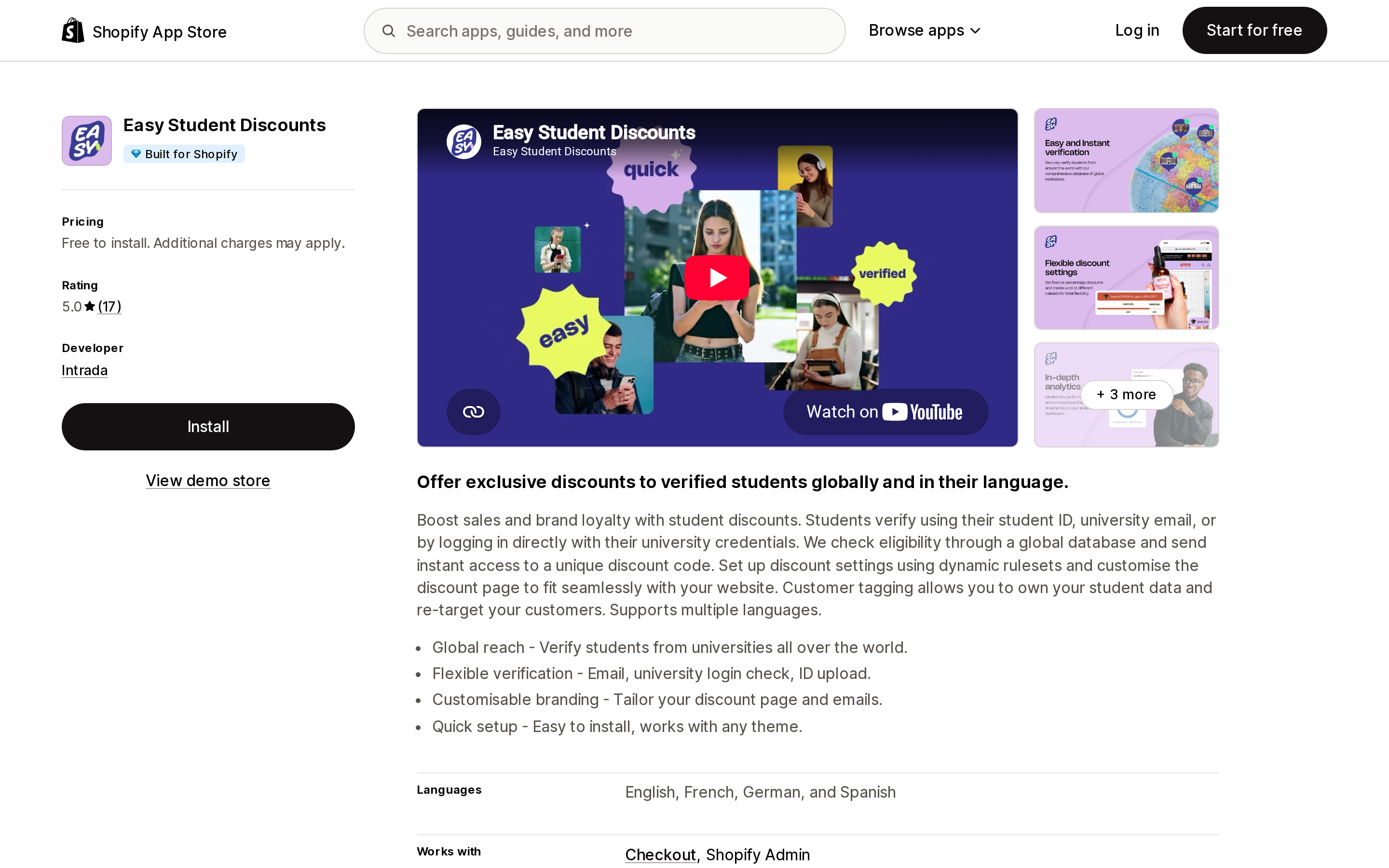
Source: Shopify App Store listing, captured September 3, 2026.
Easy Student Discounts is the only app in this comparison carrying the Built for Shopify badge, meaning Shopify's own performance, design, and integration criteria were met. It scores 5.0 across 17 reviews and ships in English, French, German, and Spanish.
The plan is free to install plus 2.5% commission on verified sales, with unlimited free email verifications and $1 each for a university login verification or a student ID upload. That rewards a specific shape of business: if most students verify by university email, verification costs nothing and you pay only the 2.5%. Three methods are offered — university email, direct login with university credentials, and student ID upload — matched against a global university database, issuing a unique code immediately. Customer tagging is included, which the vendor frames as keeping and re-targeting your own student data.
Two things to weigh. The 2.5% scales with revenue rather than effort, so a high-GMV store can pay more here than under per-verification pricing. And while the score is strong, recent reviews come predominantly from outside the US — Hong Kong SAR, Germany, Singapore — with the developer based in Birmingham, UK. US support hours are not stated in the app's official documentation.
Beans iD Verification
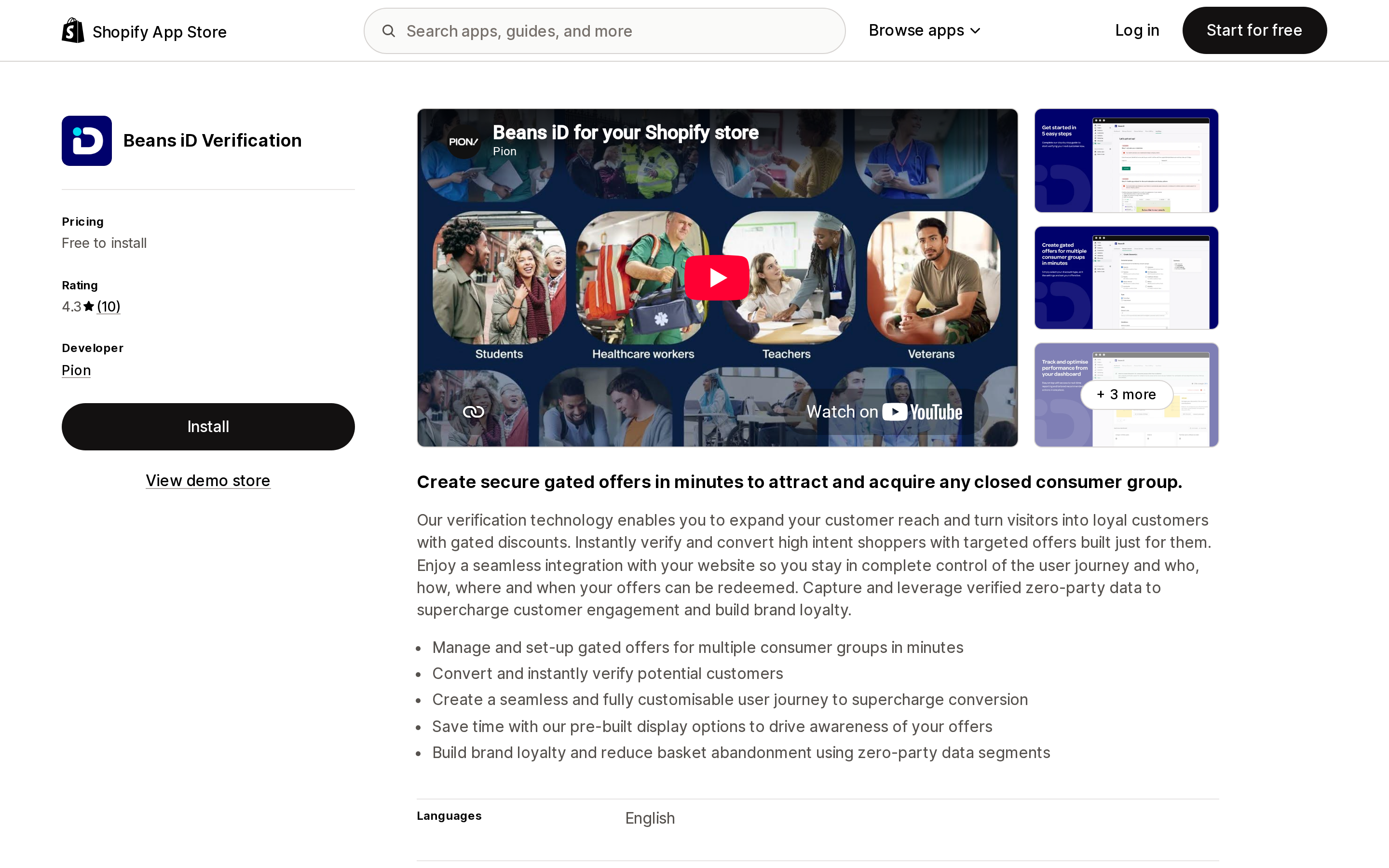
Source: Shopify App Store listing, captured September 3, 2026.
Beans iD Verification comes from Pion, the company behind Student Beans, and covers gated offers in 100-plus countries. It carries the heaviest commission here. STARTER is free to install with a 10% commission on verified sales, 30 verifications included, $1.90 each beyond. GROWTH is $125 per month plus an 8% commission, 100 verifications included, $1.30 beyond. ENTERPRISE is a custom license fee plus a commission percentage.
Note that plan tiers are defined by monthly store visits, not verification volume — under 50,000 for STARTER, 50,000 to 500,000 for GROWTH, above 500,000 for ENTERPRISE. You cannot reach a cheaper tier by verifying less.
It rates 4.3 across 10 reviews, 3 of them negative. One 1-star review from March 2023 alleges the app modified the store's discount page without notice; Pion replied publicly attributing it to a custom design layered over the app's own and calling the behavior unanticipated. The most recent review is dated December 2023 — more than two years without public feedback as of this research.
The one that isn't actually available
SheerID Community Verification
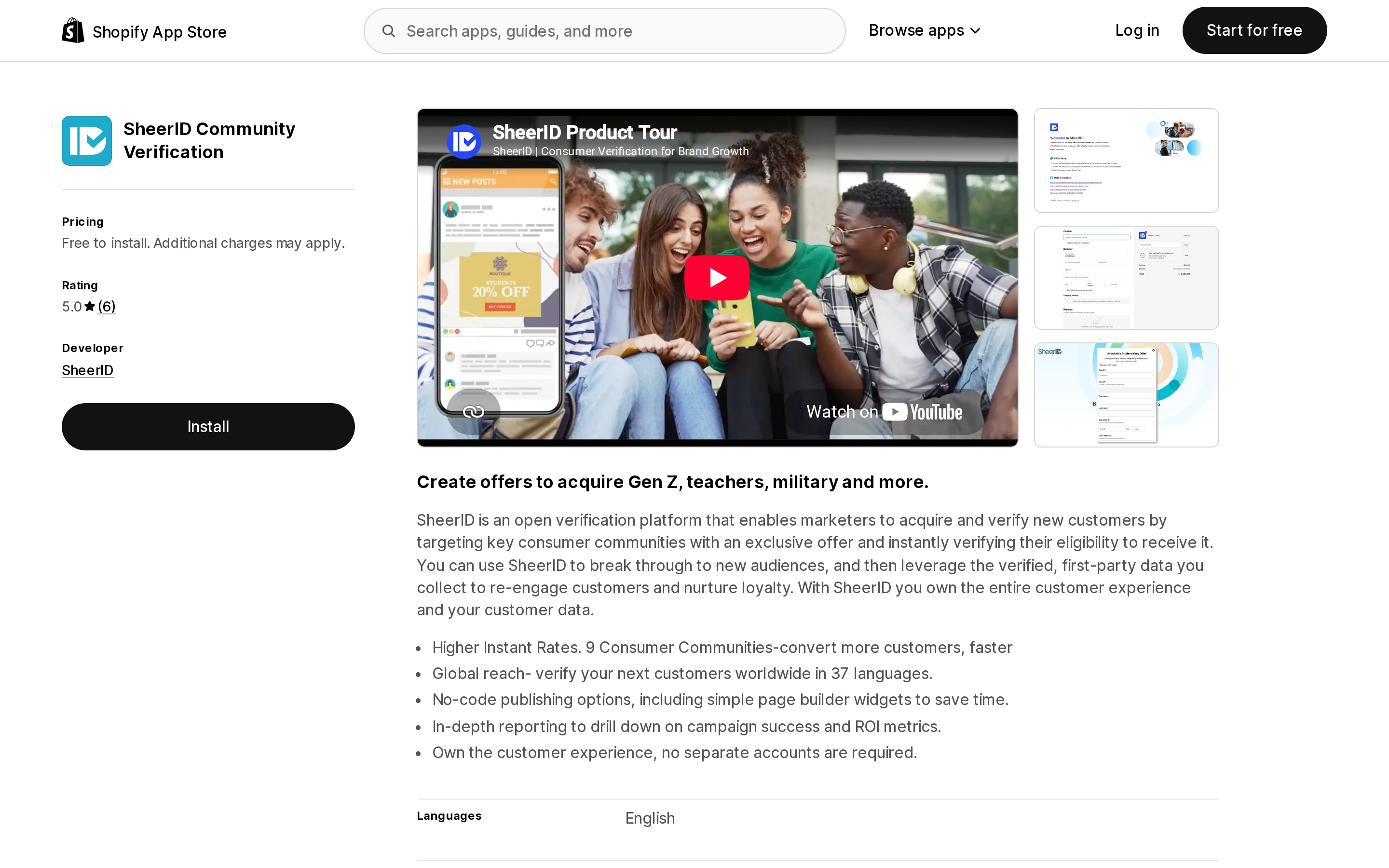
Source: Shopify App Store listing, captured September 3, 2026.
SheerID Community Verification has a live App Store listing and should not be treated as an app you can install. SheerID's own knowledge base, last updated May 5, 2026, states: "The SheerID app for Shopify is available for existing SheerID customers only." The listing reads Free to install with an "Additional Fees" plan whose amount is N/A. The real cost is a private contract and is not published, so no SheerID budget figure appears in this article.
If you already are a SheerID customer, the geographic coverage is the broadest here: verification in up to 193 countries and 37 languages, covering military, students, first responders, educators, healthcare, seniors, young adults, and low income, with 24/7 document review when instant matching fails. It offers a checkout extension app block and a theme app block and requires no separate shopper accounts.
Two implementation details differ sharply. SheerID uses a reward pool — you generate bulk discount codes in Shopify and upload them to a SheerID program, which hands them out — so pool depletion becomes your operational problem, unlike the real-time generation used by GOVX ID and VerifyPass. And SheerID documents that its Shopify app does not support account tagging, recommending the Shopify Flow app instead. Reporting and campaign management live in the MySheerID portal, outside Shopify.
Student (Education) Discount
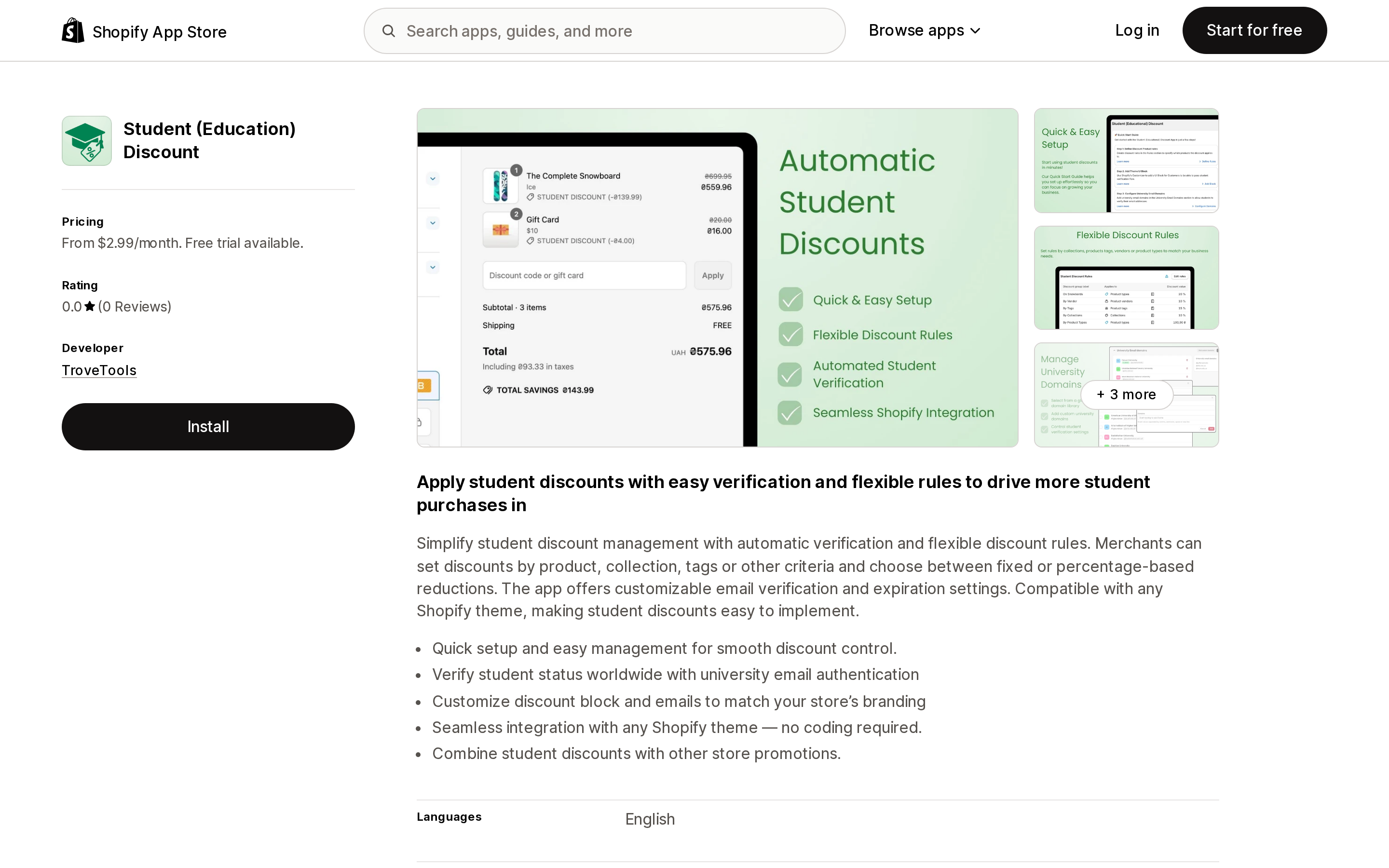
Source: Shopify App Store listing, captured September 3, 2026.
Student (Education) Discount from TroveTools is the cheapest flat-rate option: $2.99 per month for one discount rule, $5.99 for up to seven, $8.99 for up to twenty, with a 7-day trial.
It also has the weakest verification here, and the two facts are related. It matches university email domains and nothing else — no database lookup, no document review — so a graduate whose address stays live, or anyone who can obtain a university-domain alias, passes. It launched May 5, 2025 and has 0 reviews. Treat it as cheap friction, not as eligibility.
The same cost math applied to all of them
These pricing pages are not comparable as written: one charges per verification, another per dollar of revenue, a third nothing until you opt into a separate program. Here is one scenario run through each.
Assumptions. Average order value of $80. Half of verified shoppers place one order — an illustrative conversion assumption for comparison, not a figure published by any vendor. So 50 verifications produce $2,000 in verified sales, 200 produce $8,000, and 1,000 produce $40,000. Change the conversion rate and the commission rows move; the per-verification rows do not.
| Monthly verifications | 50 | 200 | 1,000 |
|---|---|---|---|
| Verified sales at these assumptions | $2,000 | $8,000 | $40,000 |
| GOVX ID (no Marketplace opt-in) | $0 | $0 | $0 |
| VerifyPass Community ID | $49.94 | $190.94 | about $850 to $905 |
| ID.me Community Verification | $62.50 | $250.00 | $1,250.00 |
| Easy Student Discounts (email only) | $50.00 | $200.00 | $1,000.00 |
| Easy Student Discounts (all login or ID upload) | $100.00 | $400.00 | $2,000.00 |
| Beans iD, STARTER | $238.00 | $1,123.00 | n/a above 50,000 visits |
| Beans iD, GROWTH | n/a under 50,000 visits | $895.00 | $4,495.00 |
| Student (Education) Discount | $2.99 to $8.99 | $2.99 to $8.99 | $2.99 to $8.99 |
| SheerID | not published | not published | not published |
Three notes. VerifyPass shows a range at 1,000 because its published table lists rates by volume band without stating whether the band rate applies to every billable verification or only to units inside each band; the two readings give roughly $848 and roughly $905. Beans iD rows are split because plan eligibility is set by store visits, not verification count. And GOVX ID's zero holds only if you stay out of the Marketplace, whose commission applies to a different traffic source and so does not belong in this column.
The pattern is worth stating plainly. Commission models get expensive as order value rises. Per-verification models get expensive as volume rises. GOVX ID's model avoids both, at the cost of covering the US only and never covering students.
Code-issuing versus customer tags
The second structural difference gets less attention than pricing and causes more implementation surprises.
Code-issuing means the app generates a discount code after verification and shows it to the shopper, who types it in. GOVX ID works this way with real-time single-use GX codes; SheerID does too, but from a pre-built reward pool. No account is required and the code cannot be shared. The cost is a code entry step, plus the job of not running the pool dry.
Customer tagging means the app writes a tag onto the customer record and a separate automatic discount fires for anyone carrying it. Nothing to type, nothing to leak. The catch is that a tag needs somewhere to live, which means the shopper needs a customer account.
VerifyPass is the only major candidate offering both, and its documentation is precise about the tradeoff. Its post-verification actions range from one shared code, through unique codes supplied by CSV upload or your own URL endpoint, to a Discount Code: Unique (Shopify) action that generates single-use codes inside Shopify in real time, to a Custom (Shopify) action that does tagging only.
Two consequences follow. First, enabling the Account Tag option applies a verifypass tag and a community_title tag — and creates a customer account if one does not exist. If your brand deliberately avoids forcing account creation, that is a change to your funnel, not a configuration detail. Second, the tag-only Custom (Shopify) action applies no discount at all. VerifyPass is explicit that it does not build automatic discount functionality, pointing instead to tag-based discount tools such as Shopacado or page-gating tools such as Locksmith. One widget runs one action, so combining a code with tagging means pairing the code action with a webhook.
SheerID sits at the opposite corner: no account tagging at all, with Shopify Flow as the recommended workaround.
Everything side by side
| GOVX ID Exclusive Discounts | VerifyPass Community ID | ID.me Community Verification | SheerID Community Verification | Easy Student Discounts | Beans iD Verification | |
|---|---|---|---|---|---|---|
| Starting price | $0 | $49/month | $50/month | Not published | $0 | $0 (STARTER) or $125/month (GROWTH) |
| Additional cost | Optional 15% commission on GOVX.com-referred orders | $0.94 down to $0.79 per verification | $1.25 per verification above 40 | Not published | 2.5% of verified sales, plus $1 per login or ID check | 8 to 10% of verified sales, plus $1.30 to $1.90 per verification |
| Free trial | Not applicable | 14 days or 49 verifications | 7 days | Not stated | 7 days | Not stated |
| Built for Shopify | No | No | No | No | Yes | No |
| Delivery method | Real-time single-use codes | Single-use codes or customer tags | Cart and checkout discounts plus tagging, per listing feature tags | Bulk codes via reward pool | Unique codes plus customer tagging | Codes, cart and checkout discounts, per listing feature tags |
| Account tagging | Not stated in official docs | Yes, creates an account if missing | Yes, per listing feature tags | No, Shopify Flow recommended | Yes | Not stated in official docs |
| Checkout placement | App block, Shopify Plus only | Not stated in official docs | Yes | Yes, checkout extension app block | Yes | Not stated in official docs |
| Shopify POS | Yes, QR plus POS tile | Not stated in official docs | Not stated in official docs | Not stated in official docs | Not stated in official docs | Not stated in official docs |
| Geography | United States only | 100-plus communities, US/UK/CA/AU residency | Not stated in official docs | Up to 193 countries, 37 languages | Worldwide | 100-plus countries |
| Verifies students | No | Yes | Not stated in official docs | Yes | Yes | Yes |
| Rating and reviews | 4.9 / 272 | 5.0 / 30 | 3.5 / 23, 39% one-star | 5.0 / 6 | 5.0 / 17 | 4.3 / 10 |
| Most recent review | September 2026 | April 2025 | August 2026 | January 2024 | July 2026 | December 2023 |
Read the last two rows together. A 5.0 across 6 reviews and a 5.0 across 30 reviews whose newest entry is from April 2025 are not evidence of the same thing, and neither says much about behavior in 2026.
Where each one fits, and where it doesn't
| App | Fits | Does not fit |
|---|---|---|
| GOVX ID Exclusive Discounts | US military, responder, nurse, or teacher pricing at zero fixed cost, code entry accepted, Shopify POS in play | Student programs, non-US customers, tag-driven automatic discounts, apparel margins that cannot absorb a 25% category minimum plus non-refundable 15% commission, checkout placement off Plus |
| VerifyPass Community ID | Several programs at once, budget fixed in advance from expected volume, a tag-based discount mechanism already in place | High volume on a tight fixed-cost budget, multi-store operators paying per storefront, anyone needing documented POS or checkout-extension support today |
| ID.me Community Verification | A US brand already using ID.me elsewhere, with a real testing window and a fallback | Small teams without support redundancy, BFCM-deadline launches, low-risk trials — nothing exists below $50 per month |
| SheerID Community Verification | Enterprise or Plus-scale international gated offers, existing SheerID customers | Self-serve installation, which is not an option, or anyone needing a budget number before committing |
| Easy Student Discounts | Student programs at zero fixed cost, mostly university-email verification, teams valuing the Built for Shopify signal | Military or first responder programs, high-GMV stores where 2.5% outgrows a flat fee, teams needing documented US-hours support |
| Beans iD Verification | High-margin brands treating the Student Beans network as an acquisition channel | Thin-margin catalogs, non-student programs, anyone needing recent public evidence of active maintenance |
| Student (Education) Discount | Cheap friction on a student offer | Any program where a wrongly granted discount actually costs something |
Decide in this order
- Do you need verification at all? If the offer is open to everyone, use native discount codes and stop.
- Do you already know who qualifies? If a human reviews IDs at low volume, tag those customers, build a segment, set it as eligibility. No app needed.
- Who are you verifying? Students rule out GOVX ID; military rules out the student-only apps. Both together points to VerifyPass, or to two apps.
- Where must verification appear? Inside checkout can mean Shopify Plus — explicitly so for the GOVX ID checkout app block. Off Plus, design for the cart or a landing page. In-store means GOVX ID.
- Code or tag? If you can require customer accounts, tagging plus an automatic discount is the better experience. If not, plan for code entry — and do not assume the app applies the discount itself. VerifyPass's tag-only action explicitly does not.
- Run your own numbers first. Put your expected monthly verifications and real AOV through the table above against your gross margin. That arithmetic changes the answer here more often than the feature comparison does.
None of this is a fraud control on its own. It is an eligibility check bolted onto a discount engine never designed to ask who you are. Choose the model whose failure mode you can live with.
Sources
- Shopify Help Center: Discount types, Amount off products and orders, Discount codes, Customer segmentation, B2B catalogs, Discounts with apps
- GOVX support: GOVX ID discounts, How the GOVX Marketplace via Shopify works, Groups verified by GOVX, Checkout button implementation, Shopify POS integration
- VerifyPass: Pricing, Post-verification actions, Shopify connection
- SheerID Knowledge Base: Shopify app information
- Shopify App Store listings and public reviews for all seven apps, retrieved September 2, 2026
The Customer object has no date-of-birth field, but Shopify ships a standard metafield definition named Birth date with the reserved key facts.birth_date, a customer segment function anniversary('metafields.facts.birth_date') that ignores the year, and a Celebrate customer birthday automation in Shopify Messaging. The native chain works end to end — storage, segment, send. What it does not solve is collection: Shopify Forms writes to a metafield you configure, the Plus-only Checkout Blocks Birthday template writes to an order metafield and, per Shopify's own note, does not apply it to the customer profile, and letting customers edit their own birth date in new customer accounts needs an extension or an app. Five real apps compared with USD pricing. Researched September 3, 2026.