
What you will learn
On this pageContentsCloseOpen
Before you shop for a return abuse app, open Settings > Policies > Return and cancellation rules. There are five things in it: a return window, who pays for return shipping, a restocking fee percentage, a list of final sale products or collections, and a cancellation window. Per-market variants exist too, but are early access.
Now read that list again with one customer in mind — the one on their eleventh return this year. Nothing in it refers to them. Every documented condition is about what is being returned or which market it is going back from. There is no documented rule condition based on a customer's return history, and no per-customer return-rate metric appears anywhere in Shopify's returns documentation.
Native return rules stop policy abuse. They do not stop a person.
Below: where native stops, why Shopify Protect does not help, the one native automation worth building first, and seven App Store apps compared on detection, enforcement and coverage.
What native does, and where it stops
Three behaviours worth internalizing. Return rules also govern manually created returns, so switching off the customer portal moves work to your inbox rather than tightening policy. Return fees are not automatically deducted from refunds. And exchanges cannot be requested through self-serve returns — Shopify states you can't have exchange-specific return rules.
Every request does land in Admin for a human, and declining requires an internal reason plus a customer-facing message. So you can stop an abusive return natively — one at a time, manually.
Shopify's fraud tooling does not close the gap either. Fraud analysis scores the order at checkout for chargeback risk using AVS, CVV, IP details and multiple cards attempted; nothing in it looks at return behaviour. Shopify Protect for Shop Pay is free but covers fraudulent and unrecognized chargebacks only, on eligible Shop Pay orders: a US merchant with a US Shopify Payments account, physical shipped items, all non-refunded line items Fulfilled, tracking from a supported carrier within 7 days and in transit within 10. An empty box arriving at your warehouse is not a chargeback.
The native automation worth building first
Shopify Flow has seven return triggers, and from Return requested it can run Add customer tags, Update customer metafield and Hold fulfillment order — free on Basic and up.
That is a serial-returner counter you can build today for $0: increment a metafield on every Return requested, tag past a threshold, and act on the tag. Flow can act, too — the Cancel return action is documented as usable from Return requested, and Shopify says that after a return is canceled "it can't be restarted without creating a new return request." Two limits: it "can't be used when a return label has been purchased through Shopify," and there is no decline action, so the customer gets no decline reason or message unless you send one yourself. With a handful of known bad actors, that is very likely the whole answer.
Detection, enforcement and coverage are three different products
Four architectures, not interchangeable:
- ML risk scoring — Loop's Fraud Tools, AfterShip's Risk assessment, Corso's Claim Risk. They produce a score; by design they deny nothing.
- Deterministic rules on customer history — ReturnZap's
Customer total number of returns, ReturnGO's RMA-count limit. Auditable, and they actually block. - Hard blocklists — Loop's
Blocklist & allowlist, AfterShip'sAdd customer to blocklist. - Economic coverage — Redo and Corso, shifting return cost onto a shopper-paid checkout fee.
Decide which you are buying before comparing prices. The ranges overlap; the products do not.
The seven apps
From the US App Store listings on September 3, 2026; ratings move, and charges are in USD. Two carry the Built for Shopify badge: AfterShip and ReturnZap. A dash means no vendor documentation was located, not that the feature is absent.
| App | From (USD/mo) | Rating (reviews) | ML score | Customer-history rule | Blocklist | Stops a return? |
|---|---|---|---|---|---|---|
| Loop Returns & Exchanges | Free / $155 flat | 4.7 (411) | Yes | Fraud-risk Workflows | Yes, manual list | No |
| AfterShip Returns & Exchanges | Free / $19, per return | 4.7 (1,394) | Yes | Request count, reason, item tag | Yes, automatic | Blocks future requests |
| ReturnGO Returns & Exchanges | $147, per return | 4.8 (364) | No | RMAs per customer, tags, type | — | Yes |
| Return Prime:Return & Exchange | Free / $19.99, per request | 4.8 (723) | No | — | — | Reason, product, window |
| Redo | Returns free | 5.0 (698) | Custom-priced add-on | — | — | — |
| Corso | Unpublished revenue share | 4.8 (19) | Yes | Cross-claim history | — | No |
| ReturnZap Returns & Exchanges | $39, 50 returns | 4.9 (102) | No | Customer total number of returns | — | Yes |
Loop Returns & Exchanges
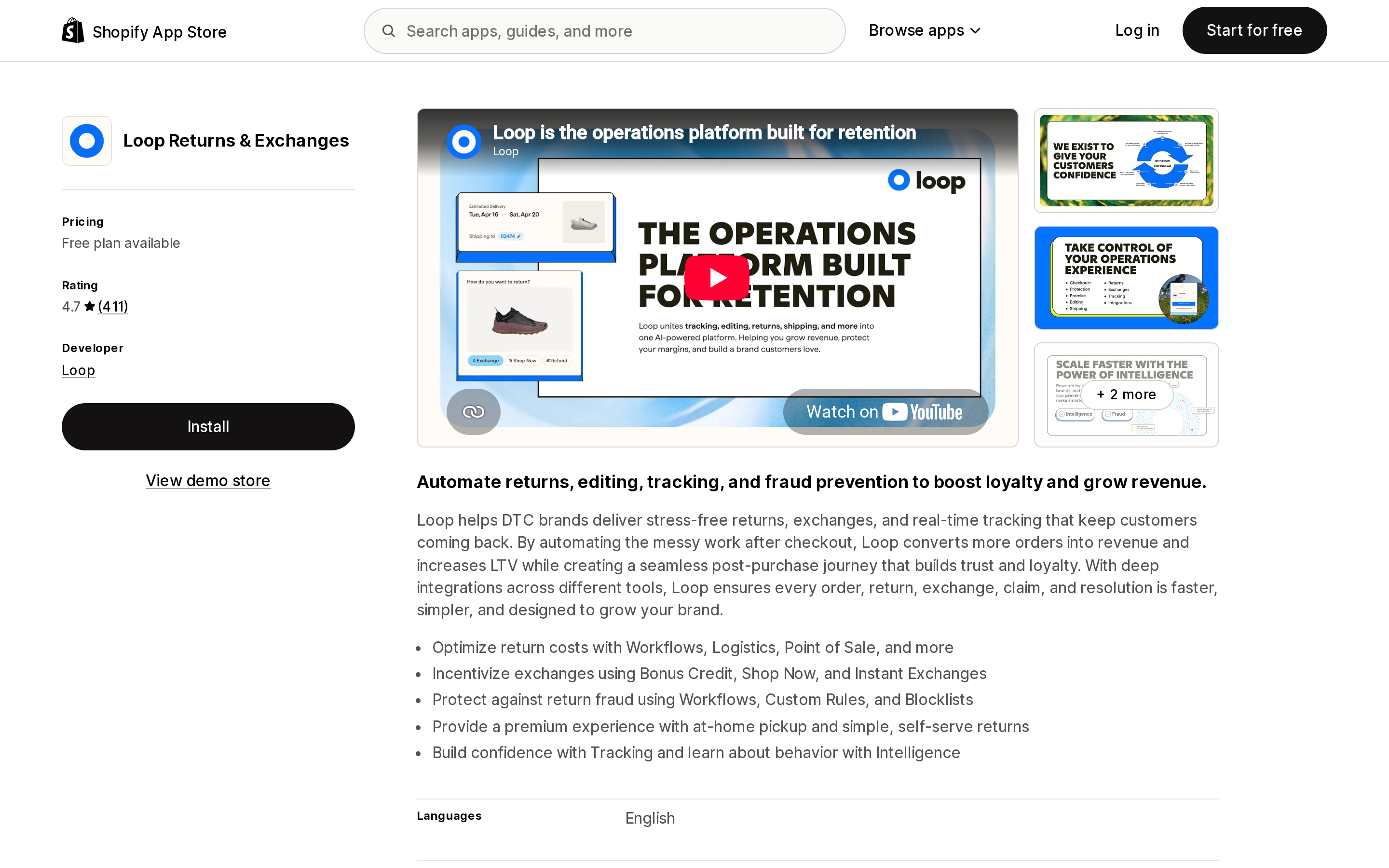
Source: Shopify App Store (Loop Returns & Exchanges), retrieved September 3, 2026
Loop, of Columbus, OH. Fraud Tools scores every return just before submission as low, high or critical risk, on device details indicating identity concealment, geographic anomalies, order and return attributes, and customer history across Loop's merchant network. But from Loop's help center: "the fraud model in and of itself does not take any actions on returns." Acting means a Workflow on the fraud high risk or critical fraud risk condition, limited to excluding return methods, excluding Keep Item, manual review, or changing the processing event. Rejecting the return outright is not a workflow action.
Blocklist & allowlist is the harder tool: block by customer email, order number, product or product tag, with CSV upload. Checkout+ is free, Essential $155/month (where Workflows appear), Advanced $340/month — though gating is ambiguous, since the listing puts "Fraud prevention" under Advanced while the Fraud Tools article says the model is available to all Loop merchants.
AfterShip Returns & Exchanges
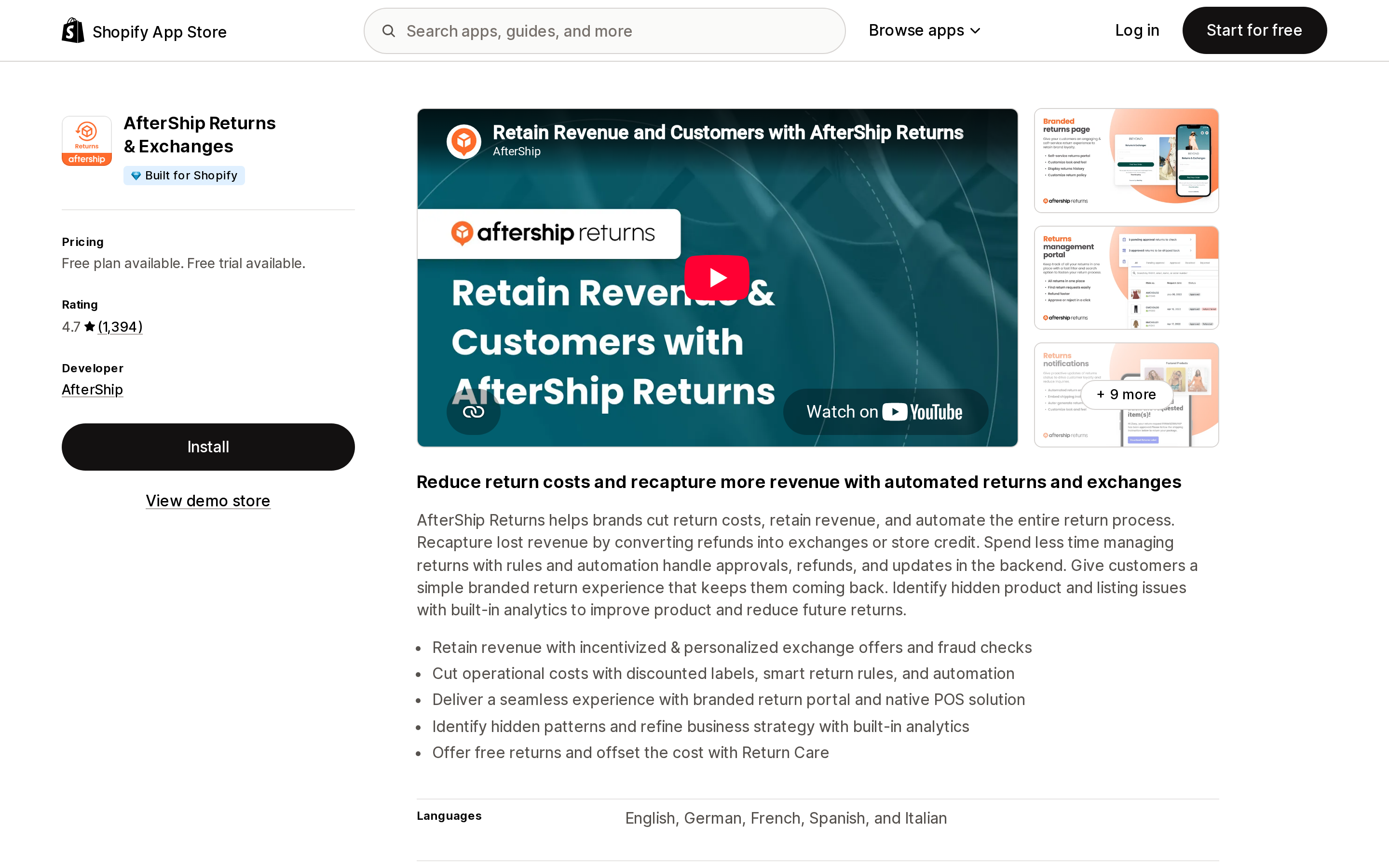
Source: Shopify App Store (AfterShip Returns & Exchanges), retrieved September 3, 2026
AfterShip, of Singapore, has the largest review base here at 1,394. Risk assessment posts a risk report on every return, using the original order's Shopify risk level, a suspicious submission IP, and an email or address matching a previously reported fraud case. Its FAQ is direct: does Fraud Risk Assessment block return requests automatically? No.
Enforcement lives in Anti-fraud workflows, whose three mutually exclusive condition groups are request frequency over a period, return package weight versus the original shipment, and first tracking checkpoint date versus the request date. Actions are Flag request for review and Add customer to blocklist, which stops that email raising any new return request — of these seven, the only blocklist we found documented as an automatic workflow action rather than a hand-maintained list, and the only vendor documentation here describing empty-box and fake-tracking detection.
Fraud prevention is on Premium at $119/month, 100 returns at $1 per extra; the $19 Essentials tier (20 returns, $0.50 extra) does not have it. Weight detection needs a carrier reporting actual package weight — AfterShip's list includes FedEx, UPS and OnTrac but not plain USPS. Multiple 2026 reviews describe finding a needed feature on a higher plan.
ReturnGO Returns & Exchanges
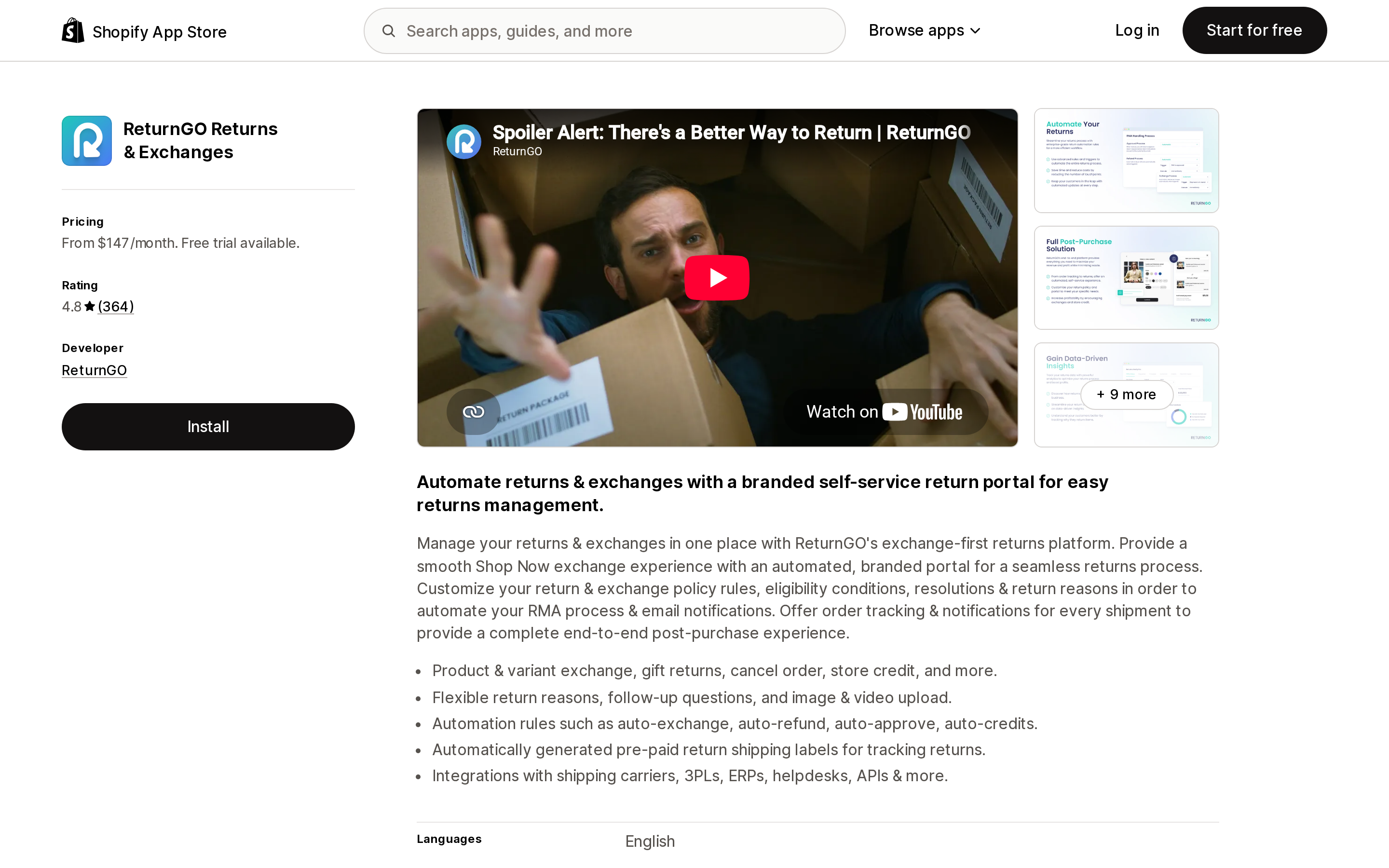
Source: Shopify App Store (ReturnGO Returns & Exchanges), retrieved September 3, 2026
ReturnGO, of Herzeliya, Israel, is deterministic rather than statistical: eligibility conditions at four levels — Order, Customer, Item and RMA — where a rule applies only if every level passes.
The relevant ones sit at customer level: the number of RMAs created by the customer, customer tag (current and historical, which pairs with Flow tagging), and customer type, letting you route guests down a stricter path than registered customers. Item level adds the number of times an item has been exchanged. One limit: AND and OR cannot be combined within a single level.
Premium is $147/month with 110 returns and $1.25 per extra; Pro is $297/month with 300 and $0.90. No ML scoring, no documented blocklist, no empty-box or fake-tracking detection.
Return Prime:Return & Exchange
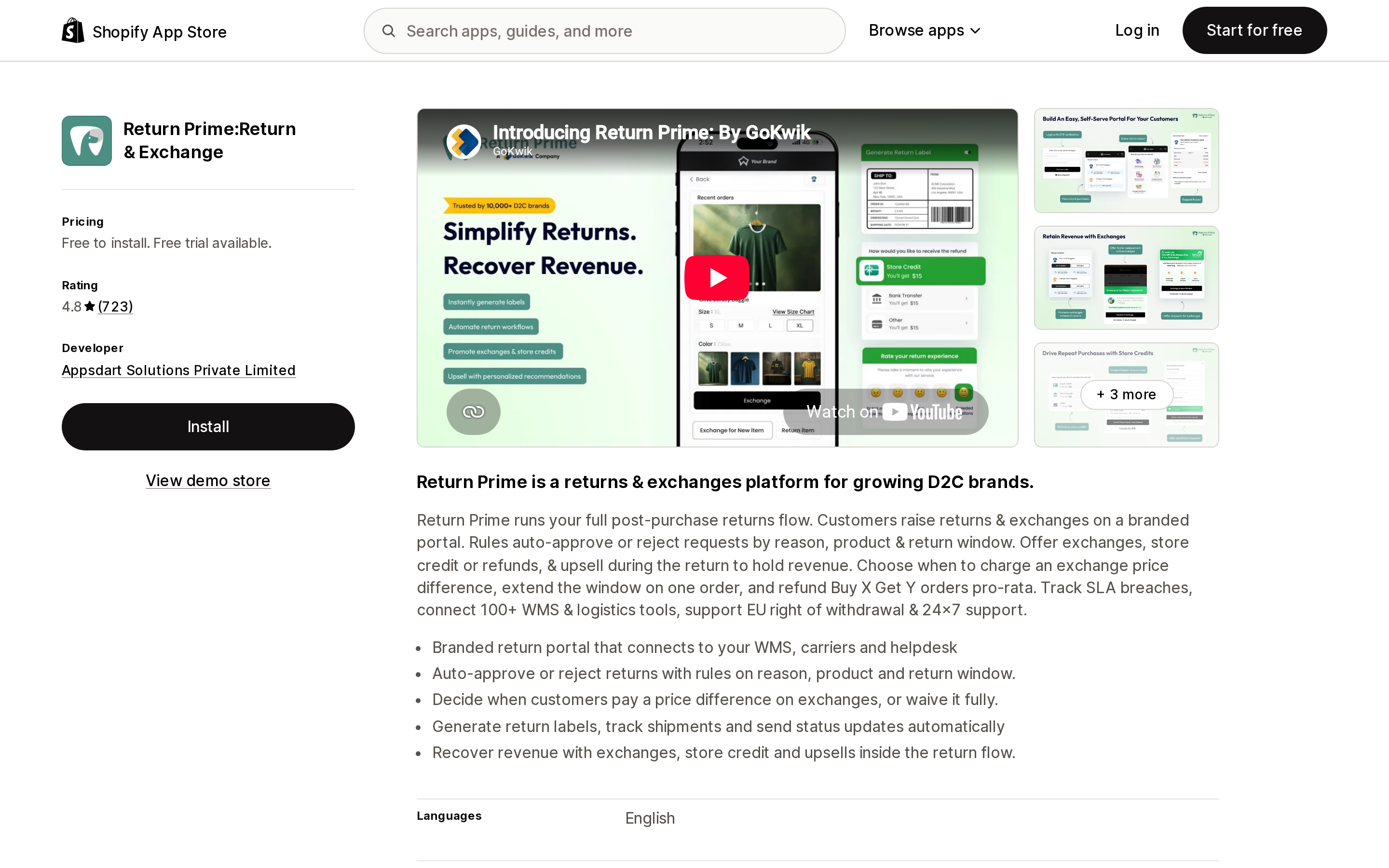
Source: Shopify App Store (Return Prime:Return & Exchange), retrieved September 3, 2026
Published by Appsdart Solutions Private Limited, with a Berlin address on the listing. Its documented rule capability, verbatim from the listing, is "Auto-approve or reject returns with rules on reason, product and return window" — the same three axes Shopify offers natively, so the incremental value is automation, not new signal. No returner risk score, customer return-count condition or blocklist could be confirmed from vendor documentation. Do not buy this one for abuse control.
Buy it for cost. Start is free to install with 5 free requests then $0.49 each; Grow starts at $19.99/month for 60; Thrive AI is $79.99/month for 180 at $0.79 per extra; Scale is $149.99/month for 450+ at $0.49 — with Thrive AI's overage higher than the tiers either side of it.
Redo
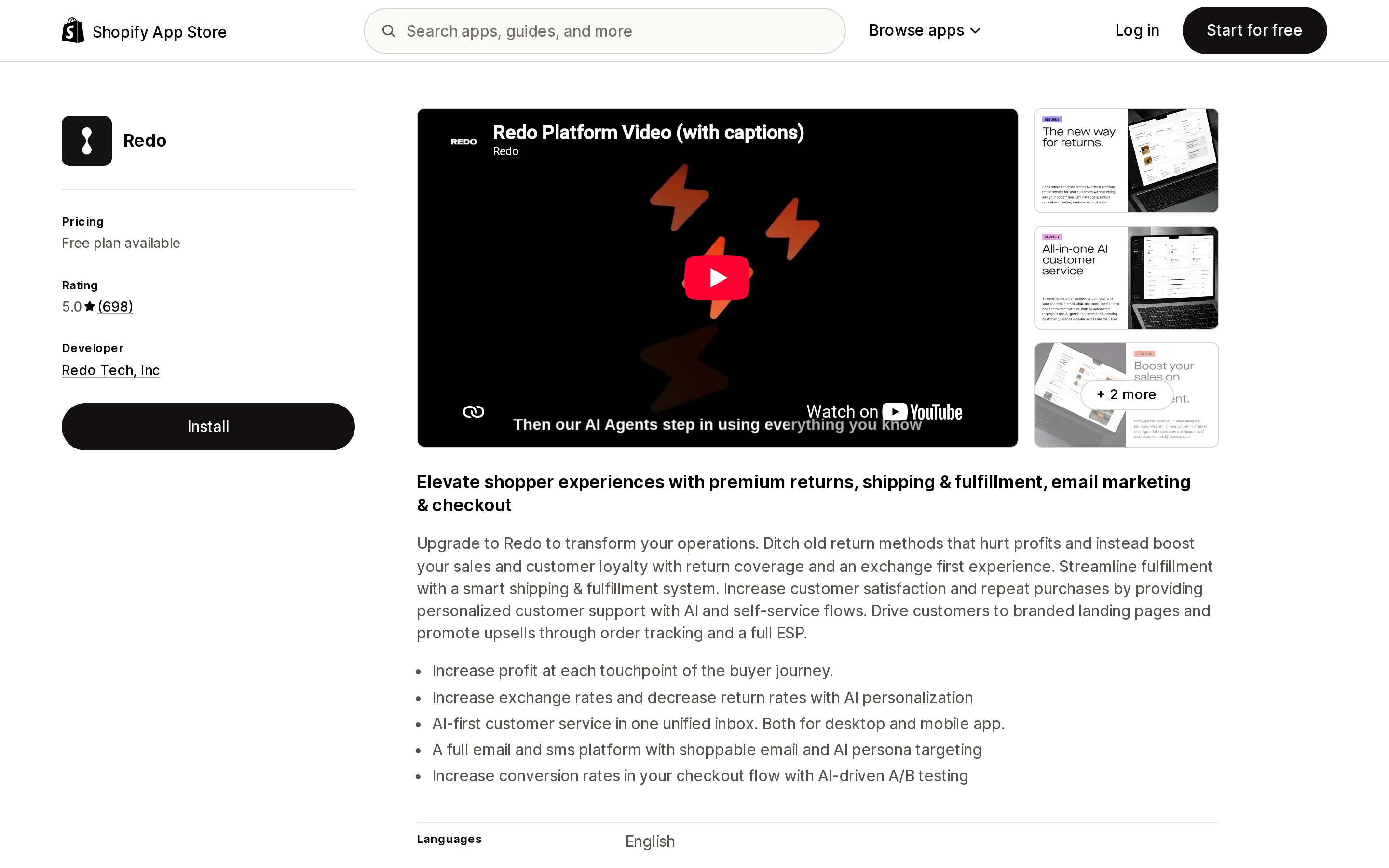
Source: Shopify App Store (Redo), retrieved September 3, 2026
Redo Tech, Inc, of Draper, UT, is the outlier: instead of policing the returner, it changes the economics so returns are covered. Returns are free — portal, AI exchange agent, variant-level analytics — and Redo states it covers the cost of your return labels. Revenue comes from adjacent modules such as Checkout Optimizer, $10/month plus $0.50 per order on the App Store card, though redo.com lists $0.40 for the same thing, so confirm which you are billed.
On abuse: fraud detection is documented as part of Claims and as part of Returns AI Agents, listed at "Custom pricing," so you cannot model the cost without a sales conversation. No published blocklist, no returner risk-score UI, no documented customer-level rule condition.
Corso
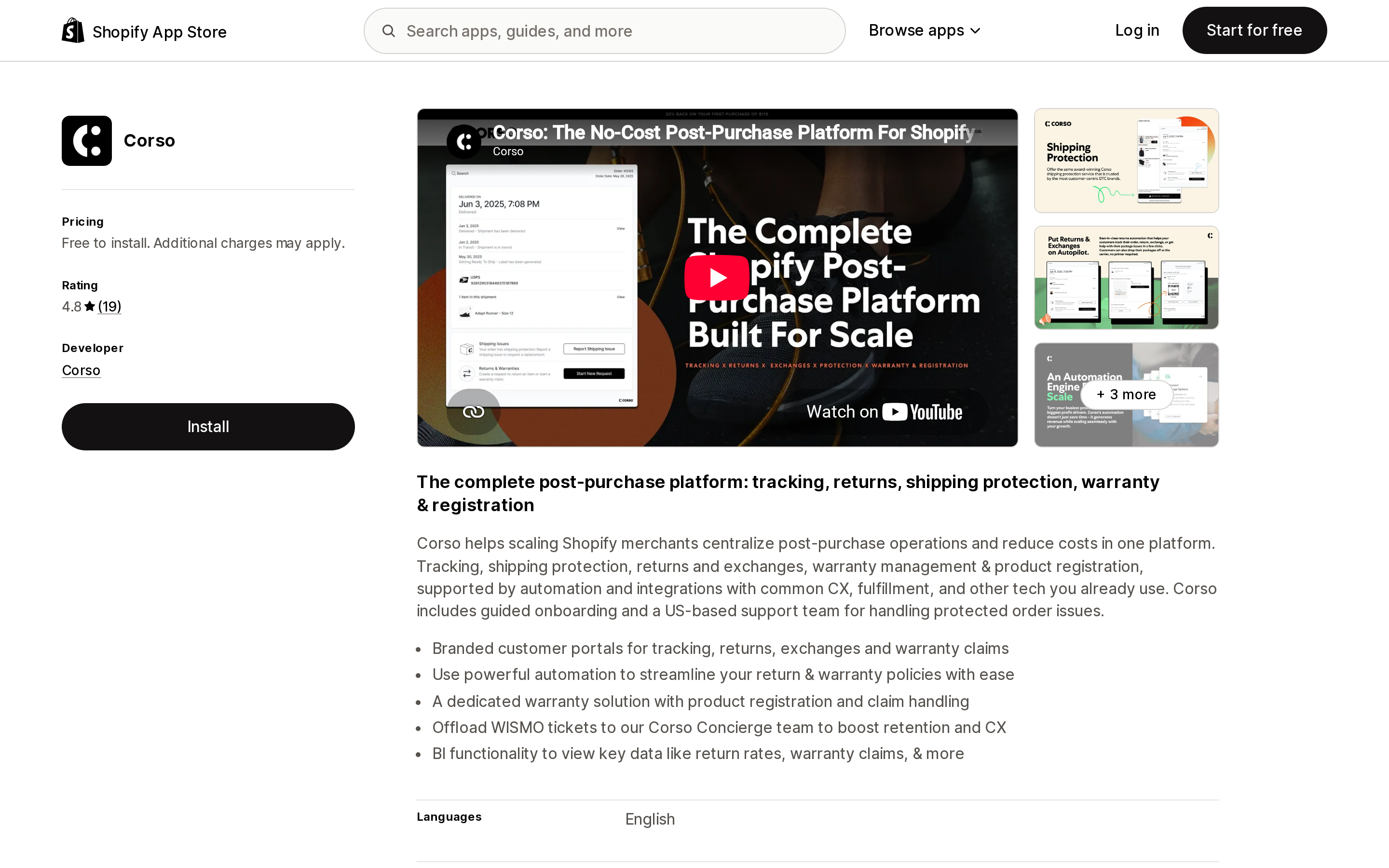
Source: Shopify App Store (Corso), retrieved September 3, 2026
Corso, of San Juan Capistrano, CA, is listed in both the returns and warranties categories, and its Claim Risk engine is the most explicitly serial-returner-shaped product here. It scores on email behavior (email age, disposable-email detection, domain reputation), device fingerprints, IP patterns, media reuse, and historical claim data — across returns, warranty claims and shipping claims on one platform. Device fingerprinting and IP clustering catch multi-account evasion, which threshold rules structurally cannot. The score is then a condition in the same rules engine handling approvals and fees: pause auto-finalization on HIGH, tag as "risk-review", auto-finalize only when risk is LOW. Corso calls this rules-based response rather than AI auto-deny.
Two hard limits. 19 reviews, thin against AfterShip's 1,394 and Loop's 411. And the price is a percentage of the revenue the platform generates, funded by customer-paid delivery protection at checkout; neither the percentage nor a typical opt-in rate is published.
ReturnZap Returns & Exchanges
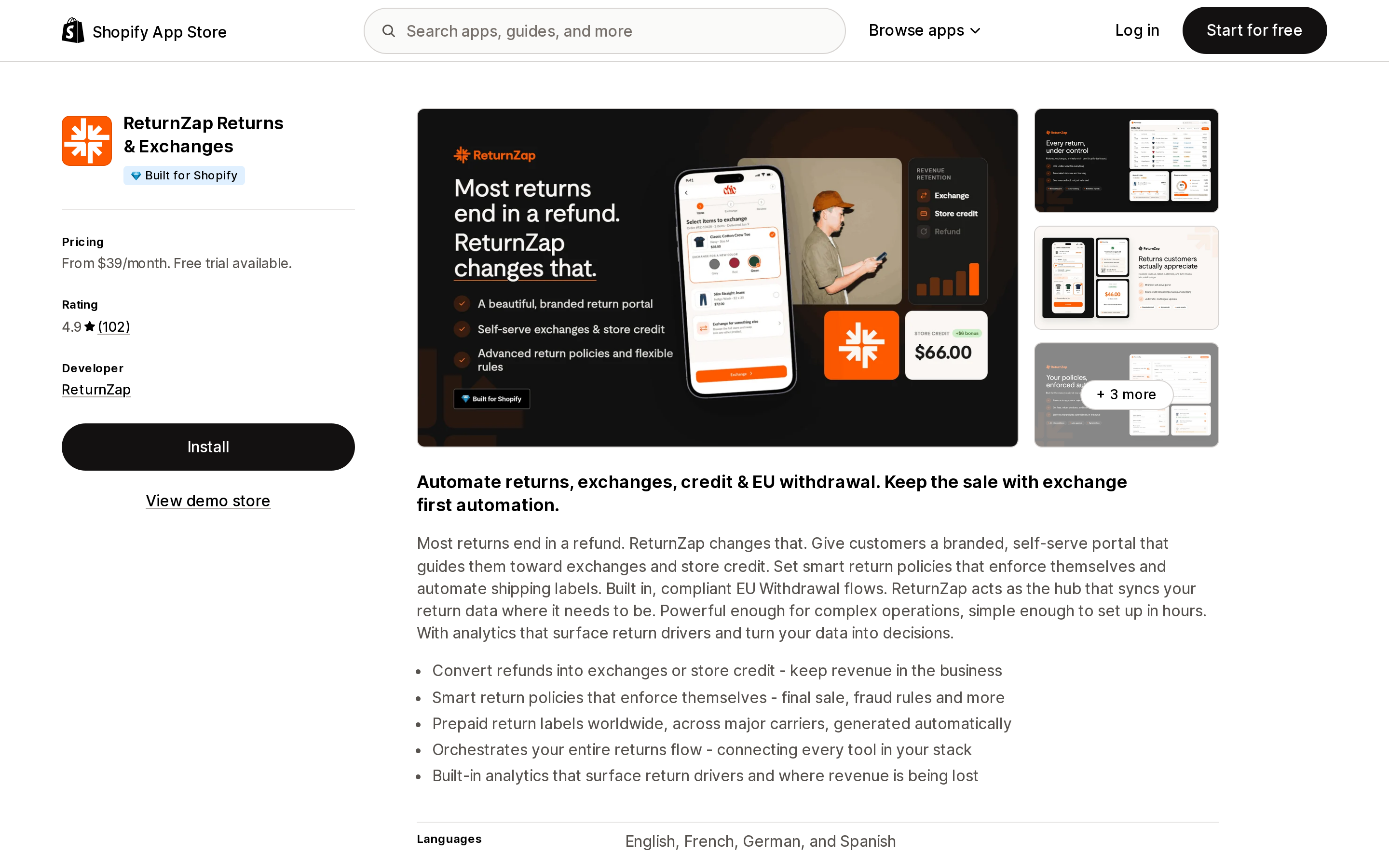
Source: Shopify App Store (ReturnZap Returns & Exchanges), retrieved September 3, 2026
ReturnZap, of Atlanta, GA, listed since May 2016 — the oldest here. Rules are When/Then, available on all plans, with nested AND and OR. Customer-level conditions include Customer total number of returns — a direct serial-returner counter — plus lifetime value, total orders, tags and country.
The action that makes it enforcement rather than reporting is Do not allow return type, which blocks all return types or specifically refunds, exchanges, same-product or cross-product exchanges, or store credit. That is how you say "this customer may still exchange, but no longer gets cash back" instead of hard-blocking them, with a custom message in the portal.
Pro is $39/month starting at 50 returns; Advanced is $69/month, adding tracking-based automations and international return labels. The overage rate is not published. Because rules are on every plan, $39/month is the lowest published monthly price in this comparison that includes a customer-history rule condition — Corso's revenue share isn't published, so it can't be ranked against it — but ReturnZap is a rules engine only, with no ML scoring, no device or IP signals, and no empty-box or fake-tracking detection.
Decide in this order
- Policy problem or person problem? Returns outside the window, final-sale items coming back, no restocking fee — configure
Return and cancellation rulesand stop. - A handful of known abusers? Stay native: Flow counts and tags on
Return requested, andCancel returnhandles the ones past your threshold. $0 beyond your plan. - Enforcement keyed on return count, at the lowest published monthly price in this set? ReturnZap Returns & Exchanges, Pro at $39/month —
Customer total number of returnsintoDo not allow return type(refunds), leaving exchanges open. - Frequency thresholds that auto-blocklist the email? AfterShip Returns & Exchanges, Premium at $119/month. Check your carrier reports package weight first.
- Complex policy that must be explainable when you decline? ReturnGO Returns & Exchanges, Premium at $147/month.
- ML flagging plus a hard blocklist at DTC scale? Loop Returns & Exchanges, Essential at $155/month for Workflows. The model flags; it does not reject.
- Same people working returns, warranty and shipping claims, or several accounts from one device? Corso is the only one of the seven whose documentation describes scoring across all three — on a negotiated revenue share, with 19 reviews.
- Returns cost too much, rather than specific people abusing them? Redo or Corso — neither a policing tool, and both dependent on shoppers opting into a paid coverage fee.
- Cheap auto-reject on reason, product and window? Return Prime:Return & Exchange, Grow at $19.99/month. Not for abuse control.
Every vendor here that publishes its philosophy — Loop, AfterShip, Corso — keeps a human in the loop and warns about false positives. Uninstall behaviour, data retention and label markup were not verified for any of the seven; ask during the trial, in writing.
There is a cost to overcorrecting, too. The NRF and Happy Returns 2025 Retail Returns Landscape found 82% of consumers cite free returns as a major purchase consideration, and its much-quoted 9%-fraudulent-returns figure comes from 358 professionals at US merchants above $500M in revenue — not an SMB number.
Sources
- Shopify Help Center: Return and cancellation rules, Set up self-serve returns, Manage self-serve returns, Return labels, Shopify Flow triggers, Return requested trigger, Cancel return action, Fraud analysis, Shopify Protect, Protect an order with Shopify Protect
- Vendor documentation: Loop Fraud Tools, Loop Blocklist and allowlist, Loop pricing, AfterShip Return Fraud Risk Assessment, AfterShip anti-fraud workflows, ReturnGO eligibility rules, ReturnZap custom return rules, Redo pricing, Corso pricing, Corso Claim Risk
- NRF, Consumers expected to return nearly $850 billion in merchandise in 2025
- Shopify App Store listings, pricing cards and public reviews for all seven apps, retrieved September 3, 2026
Shopify Flow adds and removes product tags for free on every paid plan, but its Get product data action returns at most 100 products per run, so backfilling an existing catalog becomes a scheduled loop. Flow also has no generic Product updated trigger, which means it structurally cannot re-tag a product after you edit its type, vendor, or price. Shopify Magic suggests a product category and fills category metafields, but product tag generation is not on its published feature list. The six apps compared here meter completely different units: Leap Auto Tags counts every tag added and every tag removed as one credit against 2,000 per month at $8, FilterTag meters 500 to 50,000 generated tags per month at $9 to $59, TAGit AI works out to 3 to 9 cents per generated tag, and Helium charges $9.99 one-time per 100 products. Mechanic and Matrixify charge flat fees of $16 to $199 and $20 to $200 with no per-tag metering at all. Check the denominator before you check the price. Researched September 3, 2026.