
What you will learn
On this pageContentsCloseOpen
Open the Shopify Flow trigger reference and look at what fires on a product. Product created. Product deleted. Product status updated. Product variant added. Product variant deleted. Product variant back in stock. Product variant out of stock. Product variant inventory quantity changed.
Inventory gets three dedicated triggers. Price gets none. There is no Product variant price changed, no Product price updated, nothing equivalent — and upgrading to Shopify Plus does not add one.
That asymmetry is why "notify me when it's back in stock" is a solved problem on Shopify and "notify me when it goes on sale" is not.
The gap is two holes, not one
Suppose Shopify shipped a price trigger tomorrow. You still could not send the email, because the second half is missing too.
Shopify has no native surface for a shopper to register interest in a specific product. There is no "notify me" form built into the product page, no customer-by-product subscription table, no unsubscribe path for such a subscription. Shopify Messaging (formerly Shopify Email) sends to marketing lists and customer segments, and the customer segment language cannot express "everyone watching SKU-1234." So even with a trigger, there is no audience.
Both halves are missing on every plan. This is worth saying plainly because the instinct on Shopify is usually "it's probably a Plus feature." Here it is not.
The workaround people propose in Shopify Community — a Scheduled time Flow that walks every product daily, stores the price in a metafield, and diffs it — runs into Flow's loop and run limits, has no real-time behavior, and still leaves you with nobody to email. Third-party trigger-extension apps can add a price trigger, but at that point you have installed an app, which was the question.
Verdict: this genuinely requires an app, or Klaviyo. That is not a conclusion this site reaches often.
Check your back-in-stock app before you buy anything
The most common wasted purchase here is a second app bought by someone whose existing app already does it — or, more often, the opposite: a merchant who assumes their back-in-stock app covers price drops and finds out during a sale that it does not.
The three back-in-stock apps merchants most often already have installed — two of them Built for Shopify with thousands of reviews — none of them supports price drop alerts:
| App | Reviews | Price drop alerts |
|---|---|---|
| Preorder, Back In Stock ‑ STOQ | 5.0 (3,642) | No |
| Notify Me! Back in Stock Alert | 4.9 (3,623) | No |
| Alert Me! Restock Alerts | 4.3 (239) | No |
| Back In Stock,Notify Me: Kbite | 5.0 (3,949) | Yes |
| Stok: Back in Stock Preorders | 4.8 (113) | Yes |
To check your own: open your app's App Store listing and look for a "Price drop" feature tag or an explicit mention in the listing body. Absence in both places means absence.
The billing unit is sends, not subscribers
This is where the free plans mislead. Almost every app in this category meters notifications sent per month. Collecting subscribers is free and usually advertised as unlimited — which reads as generosity and is actually the setup for the real limit.
Alert Me! Restock Alerts advertises "UNLIMITED number of sign-ups" on all four tiers, including the tier that sends 10 notifications a month. Shopstack lists "Unlimited subscribers" directly beside "30 emails/month." Both statements are true. Only one of them is the constraint.
Here is what free plans actually send, verified from the listings on September 3, 2026:
| App | Free plan send cap | Subscriber cap |
|---|---|---|
| Alert Me! Restock Alerts | 10 notifications/month | Unlimited sign-ups |
| Notify Me! Back in Stock Alert | 10 restock notifications | Not stated |
| Stok: Back in Stock Preorders | 20 email notifications/month | Unlimited collection |
| Preorder, Back In Stock ‑ STOQ | 30 emails/month | Unlimited registrations |
| Back In Stock,Notify Me: Kbite | 30 emails/month | Unlimited subscribers |
| Shopstack Restock Alert App | 30 emails/month | Unlimited subscribers |
| Restock Alert by StoreBuddies | 50 email alerts/month | Not stated |
| The Watchlyst ‑ Price Alerts | Unlimited alerts | Not stated |
| WC Wishlist & Back in Stock | No free plan | — |
Price drops have a fan-out problem that back-in-stock alerts do not. A restock notifies the people waiting on one SKU. A sitewide markdown notifies everyone watching anything, all at once. If you run a Black Friday markdown across your catalog, the entire watcher list converts to sends in a single hour. Pick your plan against your worst month, not your average one.
The six apps that actually do price drops
All pricing verified on the US App Store listing on September 3, 2026, and identical on the Japanese locale listing. All charges billed in USD.
| App | From | Metered on | Built for Shopify | Rating (reviews) |
|---|---|---|---|---|
| Back In Stock,Notify Me: Kbite | Free / $5/mo | Emails sent/month | Yes | 5.0 (3,949) |
| WC Wishlist & Back in Stock | $4.99/mo, no free plan | Emails sent/month | Yes | 4.8 (174) |
| Stok: Back in Stock Preorders | Free / $10/mo | Emails sent/month, SMS separate | Yes | 4.8 (113) |
| The Watchlyst ‑ Price Alerts | Free / $5/mo | Nothing — unlimited alerts | No | 4.4 (6) |
| Shopstack Restock Alert App | Free / $9.99/mo | Emails sent/month | No | 5.0 (4) |
| Restock Alert by StoreBuddies | Free / $4/mo unlimited | Free tier only | No | 0 reviews |
Back In Stock,Notify Me: Kbite
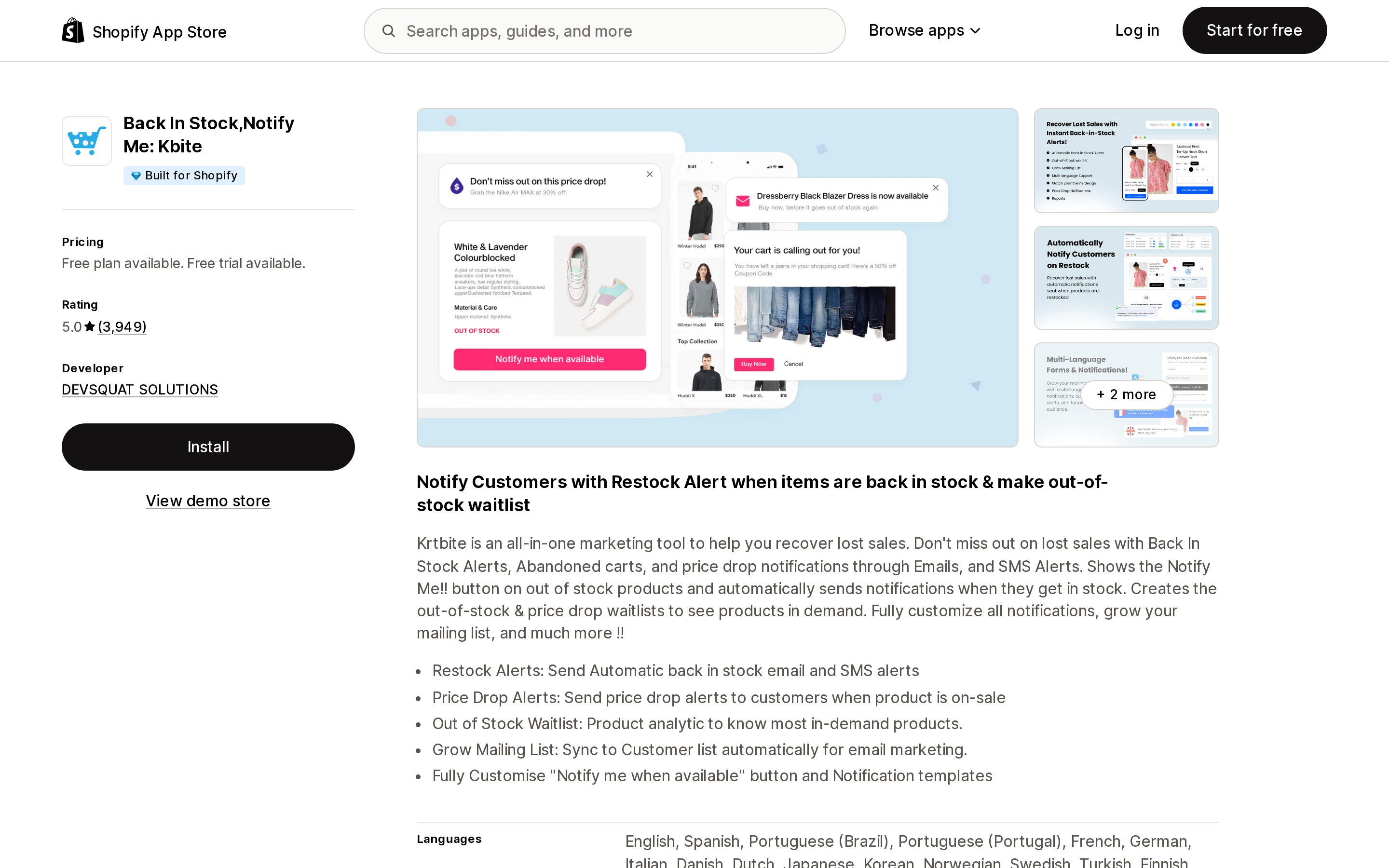
Source: Shopify App Store (Back In Stock,Notify Me: Kbite), retrieved September 3, 2026
The largest review base of any app here that does price drops: 5.0 from 3,949 reviews, Built for Shopify, by DEVSQUAT SOLUTIONS. It covers both restock and price-drop alerts from one widget.
Four tiers, all metered on emails sent: Free at 30/month, Basic $5 at 500, Starter $9 at 2,500, Pro $19 at 5,000. SMS is separate and priced by country, from $0.02 in the US. Branding removal starts at Basic; multi-language and multi-location start there too. The 14-day trial applies to paid tiers.
The cap to watch is at the top. Pro's 5,000 emails a month is the highest published tier, and what happens above it is not stated in the listing. If you are a large catalog with an active discount calendar, ask before you commit.
WC Wishlist & Back in Stock
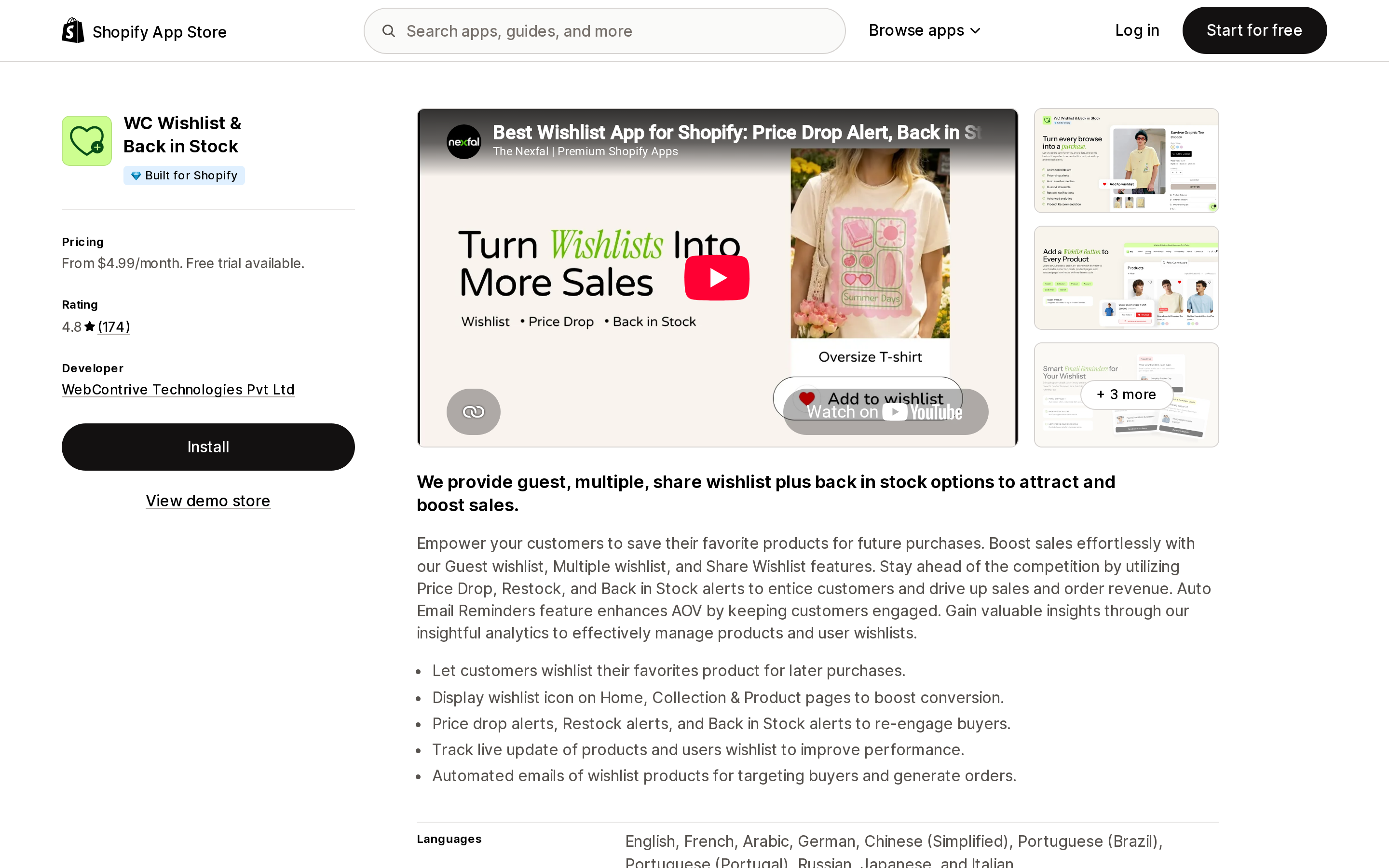
Source: Shopify App Store (WC Wishlist & Back in Stock), retrieved September 3, 2026
The interesting structural choice here: price alerts arrive attached to a wishlist rather than a per-product notify button. A shopper saves items, and restock, price-drop, and low-stock alerts fire against the saved list. If you already wanted a wishlist, you get the alerts effectively for free; if you did not, this is more surface area than you asked for.
No free plan at all — Basic starts at $4.99/month, or $50.88/year for a 15% saving, with 500 email notifications. Pro is $9.99 at 2,000, Advance $14.99 at 5,000, Enterprise $24.99 at 10,000. Built for Shopify, 4.8 from 174 reviews, and Shopify Markets support is listed on every tier. It explicitly supports guest wishlists, which matters if you cannot require customer accounts.
Among apps that both support price drops and have a review base worth reading, this is the strongest. The tradeoff is that you cannot pilot it for free.
Stok: Back in Stock Preorders
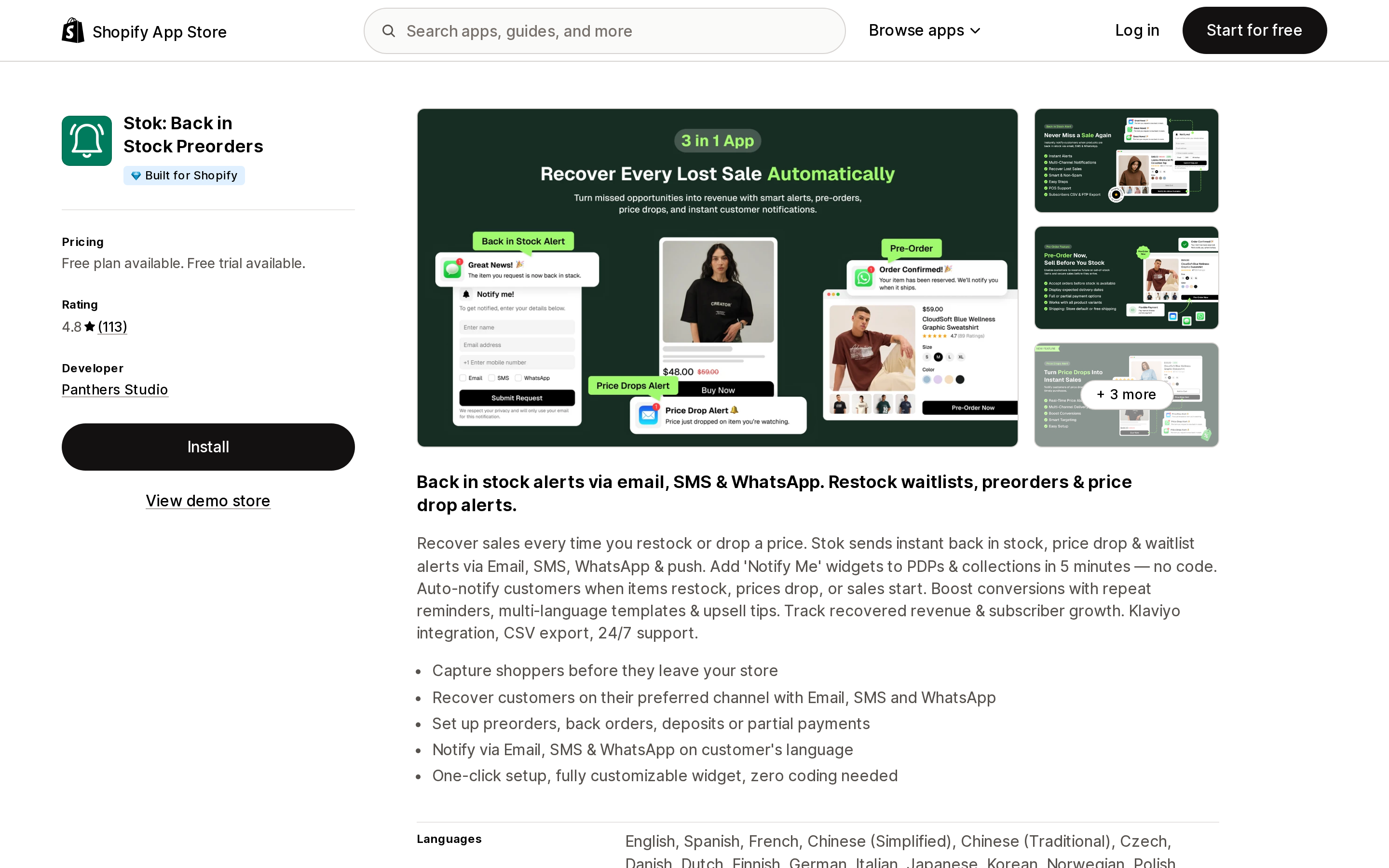
Source: Shopify App Store (Stok: Back in Stock Preorders), retrieved September 3, 2026
Restock, price drop, and preorder in one app, Built for Shopify, 4.8 from 113 reviews. Widgets go on both product and collection pages, and subscriber collection is unlimited on every tier.
Read the tiers carefully, because the entry paid plan is not the deal it looks like. Free sends 20 emails a month and does not show you subscriber contact details. Plus at $10 raises that to 100 emails and unlocks email, SMS, and WhatsApp channels and subscriber contact details. Pro at $20 is where multi-language notifications, domain authentication, log previews, FTP and CSV subscriber export, and Klaviyo integration arrive. Business is $49.99. SMS is metered separately from $0.02.
If you are sending more than a hundred alerts a month — and a single markdown will — treat $20 Pro as the real starting price. Domain authentication landing on that tier is not incidental either: price-drop email goes to people who have never bought from you, which is exactly the traffic that gets filtered when it comes from a shared app sender domain.
The Watchlyst ‑ Price Alerts
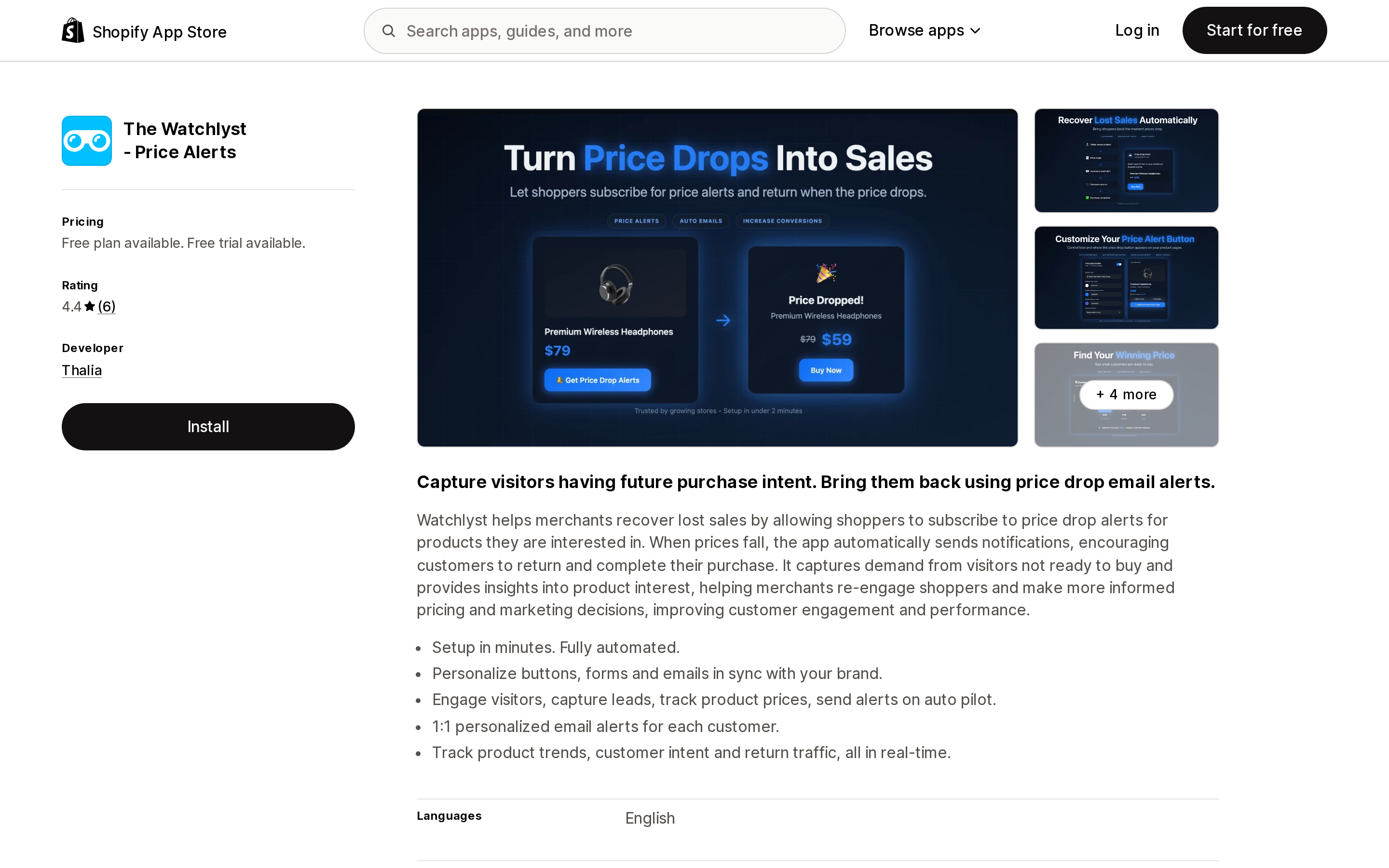
Source: Shopify App Store (The Watchlyst ‑ Price Alerts), retrieved September 3, 2026
The only app here that is purely about price, and the only one listed under Pricing optimization rather than Stock alerts. Running since October 2016.
Its pricing is the outlier that makes it worth considering: both plans say "Unlimited Alerts." The Free plan sends unlimited alerts. The $5 Basic plan sends unlimited alerts and adds multi-language and multi-region support. You are paying for features, not for volume. In a category where every competitor meters sends, an unmetered $5 plan removes the entire fan-out risk described above.
The cost of that is evidence. Six reviews, 4.4 average, no Built for Shopify badge, English only on the free tier. One review from April 2026 reports a server error that took the service down, with the developer replying that it was fixed. Six reviews across ten years is not a quality signal in either direction — it is an absence of signal.
Shopstack Restock Alert App
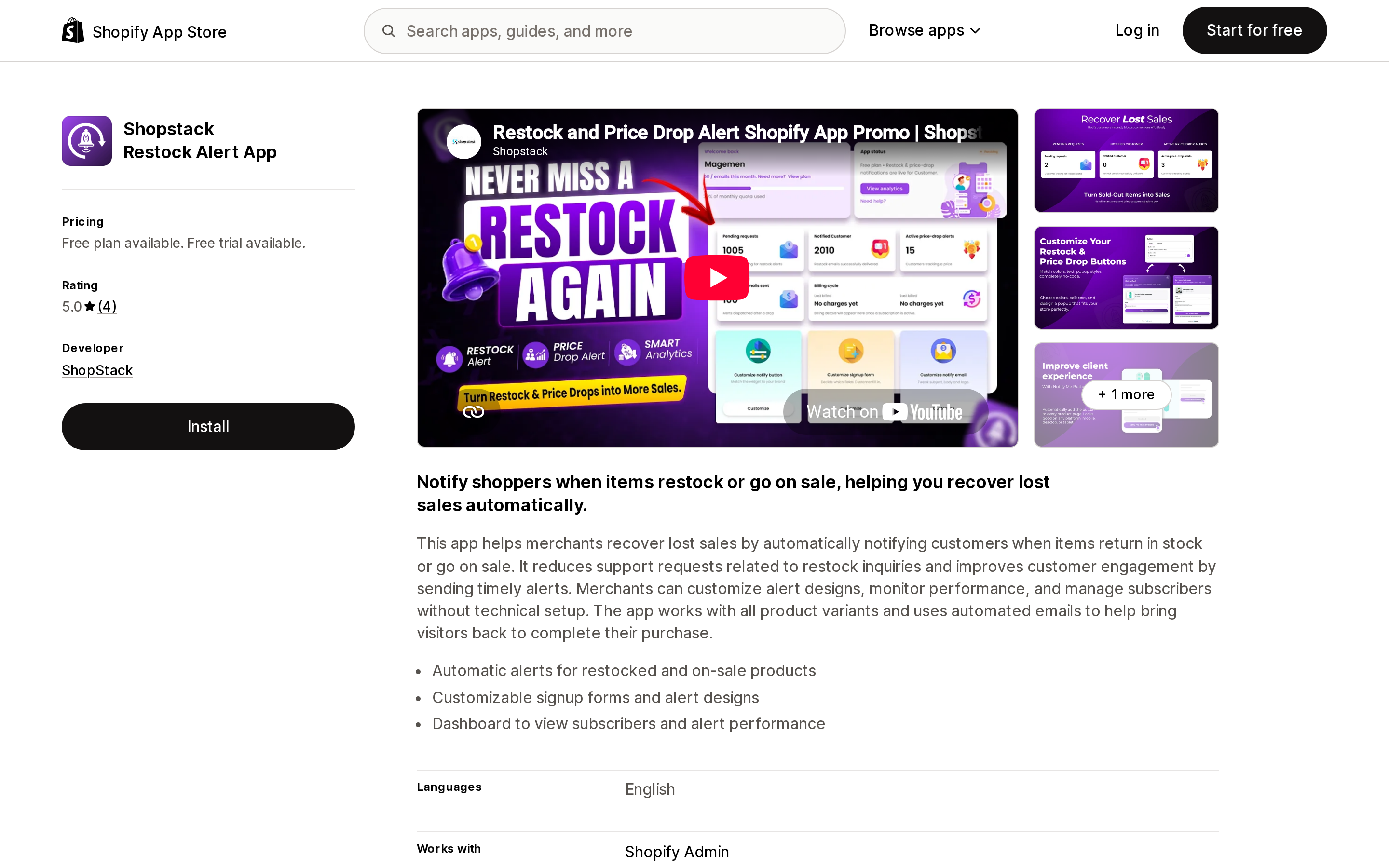
Source: Shopify App Store (Shopstack Restock Alert App), retrieved September 3, 2026
Restock and price-drop alerts with the cleanest tier ladder in the group: Free at 30 emails/month with basic 30-day insights, Lite $9.99 at 1,000, Starter $19.99 at 3,500, Pro $39.99 at 10,000, each with a 20% annual discount. Custom email templates and sending from your own domain start at Starter, which is the tier that matters for deliverability.
Four reviews and a December 2025 launch. One review notes the difficulty of finding an app that works without requiring shopper accounts — a useful reminder that guest support is not universal in this category and is worth confirming for whichever app you pick.
Restock Alert by StoreBuddies
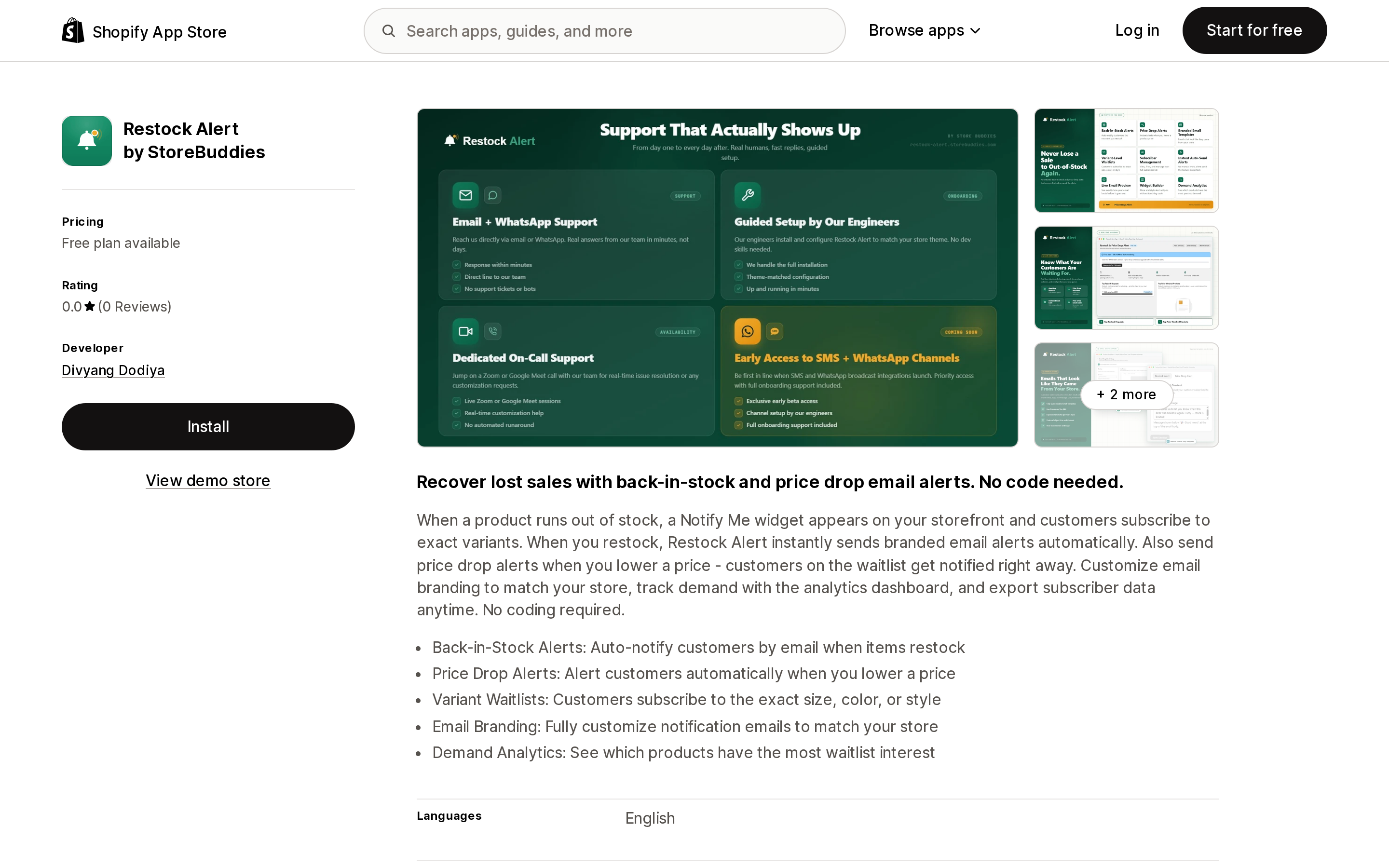
Source: Shopify App Store (Restock Alert by StoreBuddies), retrieved September 3, 2026
The cheapest unmetered option: Free sends 50 alerts a month including price-drop alerts, and the paid plan at $4/month sends unlimited restock and price-drop alerts, with priority delivery, CSV subscriber export, and branding removal.
Zero reviews, launched May 2026. That is the whole risk statement. The pricing model is the most rational one in this comparison and there is nobody's production experience to check it against. If the flat-rate model is what you want and you can tolerate being an early user, this and The Watchlyst are the two options — one with six reviews, one with none.
The Klaviyo alternative, and what it quietly changes
If you already run Klaviyo, there is a Price Drop flow and it costs you nothing extra. But it works on a different premise, and the difference matters more than the price.
Klaviyo's flow triggers on behavior, not on opt-in. It fires for people who had a Viewed Product or Started Checkout event on that product within a lookback window, 30 days by default. Nobody clicked "notify me." That is a much larger audience, captured passively — and it is also a message to people who never asked for it, which is a judgment call about your list rather than a feature comparison.
Three constraints worth knowing. It only sends for in-stock items. It does not send to prior purchasers of that product. And price-drop events are only recorded while the flow is live or manual, so it never fires on a markdown that happened before you built it.
The billing model differs too. Klaviyo meters account-wide active profiles, not price-drop sends, so the flow itself adds no marginal cost — but you are paying for your whole marketing database. Klaviyo prices the Email plan by active-profile tier on an interactive slider, so check your own profile count on their pricing page before you budget against it.
The honest framing: Klaviyo captures more people but never gets consent, and an app captures fewer people who explicitly raised their hand. The second list is smaller and converts on intent. Some stores should run both.
Decide in this order
- Can I do this natively? No. No Flow price trigger, no subscription surface, on any plan. Stop looking.
- Does my current back-in-stock app already do it? Check the listing for a "Price drop" tag. STOQ, Notify Me!, and Alert Me! do not.
- Do I already pay for Klaviyo, and do I discount in-stock items? Build the Price Drop flow. Zero marginal cost. Accept that recipients never opted in.
- Do I want an explicit "tell me when this is cheaper" button? Then you want an app — Klaviyo cannot capture that signal, and that signal is also demand data you can read.
- How many alerts will my worst month send? Multiply watchers by the number of SKUs you mark down at once. If that number is unpredictable, buy an unmetered plan: The Watchlyst at $5 or Restock Alert by StoreBuddies at $4, both with the review-count caveat above.
- Do I need proof the vendor is solid? WC Wishlist & Back in Stock (4.8, 174 reviews, Built for Shopify) if you can start paid, or Back In Stock,Notify Me: Kbite (5.0, 3,949) if you want one app for restock and price drops.
- Will my customers be logged in? If not, confirm guest subscription support explicitly before installing.
- Am I planning to run this on a free plan? Unless you pick The Watchlyst, you will send between 20 and 50 emails a month. That is a proof of concept, not an operating budget.
Sources
- Shopify Help Center: Shopify Flow trigger reference, Shopify Messaging, Customer segmentation
- Klaviyo Help Center: How to create a price drop flow
- Shopify App Store listings, pricing tabs, and public reviews for all apps named, retrieved September 3, 2026
The Customer object has no date-of-birth field, but Shopify ships a standard metafield definition named Birth date with the reserved key facts.birth_date, a customer segment function anniversary('metafields.facts.birth_date') that ignores the year, and a Celebrate customer birthday automation in Shopify Messaging. The native chain works end to end — storage, segment, send. What it does not solve is collection: Shopify Forms writes to a metafield you configure, the Plus-only Checkout Blocks Birthday template writes to an order metafield and, per Shopify's own note, does not apply it to the customer profile, and letting customers edit their own birth date in new customer accounts needs an extension or an app. Five real apps compared with USD pricing. Researched September 3, 2026.