
What you will learn
On this pageContentsCloseOpen
A US merchant who wants buyers to ship to a UPS Access Point, a FedEx location, or a parcel locker usually opens the Shopify admin's shipping and delivery settings and finds an entry called Pickup points. That looks like the answer. It is not, at least not for a store in the United States.
Shopify documents that the feature is limited to stores in France, Italy, Spain, and the UK, plus eligible Shopify Plus stores running a custom app. The supported carriers are Evri, Colissimo, Correos, Mondial Relay, and Poste Italiane. UPS, FedEx, and USPS are not on that list. As of September 2026, a US store has no native route to third-party pickup points.
That pushes the decision to the App Store, where a second and less obvious problem starts. Installing an app does not mean the pickup point selector will appear inside checkout. Merchants often assume that comes down to carrier-calculated shipping. For some apps it does. For others the requirement is Shopify Plus, and no amount of carrier-calculated shipping changes it. On a non-Plus plan most of these apps still work, but the shopper picks their location somewhere other than checkout — and each vendor chose a different somewhere.
Below: what Shopify does natively, the two gates on checkout, and three apps compared on US-relevant criteria. Research date: September 3, 2026. Prices in USD.
The short version
Shopify has no native pickup point option for US stores, and Pickup in store does not substitute for it — that setting covers your own locations only.
Public App Store apps cannot build on the native pickup point API. Shopify's developer documentation says so explicitly, so every app here builds its own interface instead.
Two different requirements block the checkout page. Carrier Service API apps need third-party carrier-calculated shipping; checkout extensibility apps need Shopify Plus. Knowing which one an app uses tells you what upgrade would help.
The fallback differs by app. Atlas Pickup Points falls back to the Thank you page, Octolize Pickup Points PRO to the cart page.
USPS pickup points did not appear in any carrier list we checked.
What Shopify does natively
Pickup in store covers your locations, not carrier networks
Shopify's documentation lists no plan requirement for Pickup in store — you need at least one location that fulfills online orders and the latest version of checkout — and it is enabled per location. It supports store transfers, so an order can be collected at a location that did not hold the stock, and a single order can mix shipped and picked-up items. What it cannot do is point at someone else's building: every step of the setup is tied to a location you own, so a UPS Access Point three blocks from the customer is not expressible here.
Native Pickup points exists, and US stores are outside it
The native pickup points feature is the genuine PUDO implementation, and it is in early access. Shopify limits it to stores and fulfillment locations in France, Italy, Spain, and the UK, and to eligible Shopify Plus stores.
Constraints apply even to eligible stores. Shopify states that if the customer pays with Apple Pay, Google Pay, Amazon Pay, or PayPal, shipping to pickup points is not available. B2B checkouts are excluded, all physical items must ship from one location with stock on hand, and stores on the Plus custom app route cannot buy shipping labels through Shopify for those orders.
This is worth watching rather than dismissing — early access programs expand, and the country list is among the likelier things here to change. But a US store cannot plan around it today.
App Store apps cannot use the native pickup point API
Shopify's developer documentation states that public apps in the Shopify App Store, and custom apps built for stores on non-Plus plans, are not eligible to build for pickup points. Installing an app therefore does not connect you to Shopify's native pickup point machinery. Each vendor built its own selector on other primitives — checkout UI extensions, a theme app extension on the cart, a Thank you page block — which is why behavior and plan requirements vary so much between apps that look alike.
The two gates on checkout
Merchants researching this usually land on third-party carrier-calculated shipping (CCS) and stop there. CCS is one gate, not the only one.
Gate 1 — CCS, for Carrier Service API apps. Shopify documents CCS as available on Advanced and Plus, with Grow stores able to add it for an additional monthly fee or by switching to annual billing. Basic has no path. Shopify does not publish the add-on price; Atlas's documentation cites $20 USD per month paid to Shopify, which is a vendor figure rather than a Shopify-published one.
Gate 2 — Shopify Plus, for checkout extensibility apps. Shopify's developer documentation states that checkout UI extensions rendering on the information and shipping and payment steps are available only to stores on a Shopify Plus plan. CCS is irrelevant here. Atlas's own documentation says the app does not use the Carrier Service API and is built on checkout extensibility, and attributes the Plus requirement to that platform rule.
| Capability | Basic | Grow | Advanced | Plus |
|---|---|---|---|---|
Pickup in store (your own locations) | Yes | Yes | Yes | Yes |
Native Pickup points (FR / IT / ES / UK only) | No | No | No | Via custom app |
| Third-party carrier-calculated shipping | No | Annual billing or paid add-on | Included | Included |
| Checkout UI extensions on the shipping and payment steps | No | No | No | Yes |
Read that table with your candidate app in hand. If the app uses the Carrier Service API, moving from Basic to Advanced unlocks checkout. If the app uses checkout extensibility, that same upgrade changes nothing and only Plus does.
Where the picker goes when checkout is unavailable
| App | In-checkout requirement | Fallback surface | Fallback price |
|---|---|---|---|
| Atlas Pickup Points | Shopify Plus (Pro, $69/month) | Thank you page, after payment | Lite, $39/month, all plans |
| Octolize Pickup Points PRO | CCS for a list, Plus for a map | Cart page widget, before payment | Basic tier, $9.99/month |
| Sendcloud | Shipping Platform | Not stated in the app's listing | Not stated in the app's listing | Free plan lists service points in checkout |
These two fallbacks fail in opposite ways, and that should drive the choice more than the price gap does.
The Thank you page route captures payment before the buyer picks a location, so you can end up with paid orders that have no pickup point attached. Atlas offers automatic assignment of the nearest point for that case, closing the operational gap at the cost of possibly not matching what the buyer wanted. The cart page route puts selection before payment, which is better — as long as the buyer visits the cart. Buy Now buttons and direct-to-checkout drawer setups skip it, and those buyers reach checkout with no pickup option ever shown.
Atlas Pickup Points
Source: Shopify App Store (Atlas Pickup Points), retrieved September 3, 2026
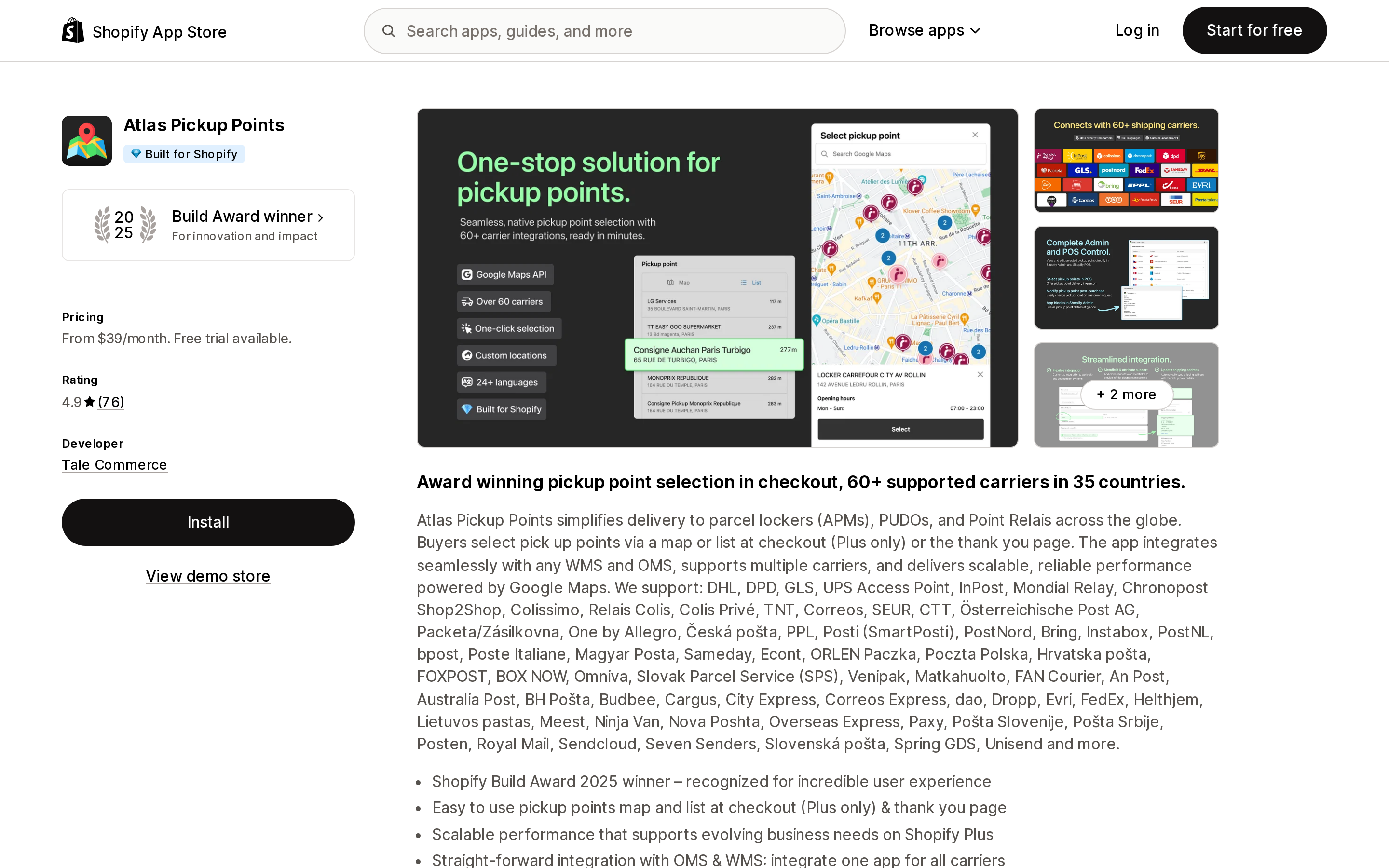
Built by Tale Commerce and launched July 31, 2023, Atlas Pickup Points carries the Built for Shopify badge and a 2025 Build Award, and rates 4.9 out of 5 across 76 reviews as of September 3, 2026. For US merchants the decisive detail is coverage: Atlas is the only one of the three apps here that publishes a per-country carrier list, and its United States page names three carriers — FedEx, UPS, and DHL. Its UPS page describes Access Points, parcel lockers, parcel shops, and post offices across Europe and North America. USPS does not appear.
Pricing is Lite at $39/month or $420/year, Pro at $69/month or $708/year, and Enterprise at $299/month or $2,990/year, with a 14-day free trial and no free plan. Lite works on all Shopify plans and puts selection on the Thank you page; Pro adds in-checkout selection, requires Shopify Plus, and includes checkout blocking that stops an order completing without a pickup point. The vendor states there are no per-order, transaction, or volume fees, and that all carriers and countries are included on every plan. One discrepancy: the App Store listing says 35 countries, while the vendor's own site says 40.
Two costs are easy to miss — a Google Maps API key billed to you by Google, and credentials from your own UPS and FedEx accounts. Atlas also states directly that it does not create shipping labels, and tracking and returns to pickup points are out of scope; the selection is written to an order metafield for a WMS or 3PL to read. ShipStation, Shippo, and EasyPost are not among the listed integrations, so US merchants on those tools should expect to build the handoff.
Recent reviews are from Spain, Poland, and Germany, several praising support responsiveness. One welcomes the Thank you page workaround while calling it not ideal, which is a fair summary of that tradeoff.
Octolize Pickup Points PRO
Source: Shopify App Store (Octolize Pickup Points PRO), retrieved September 3, 2026
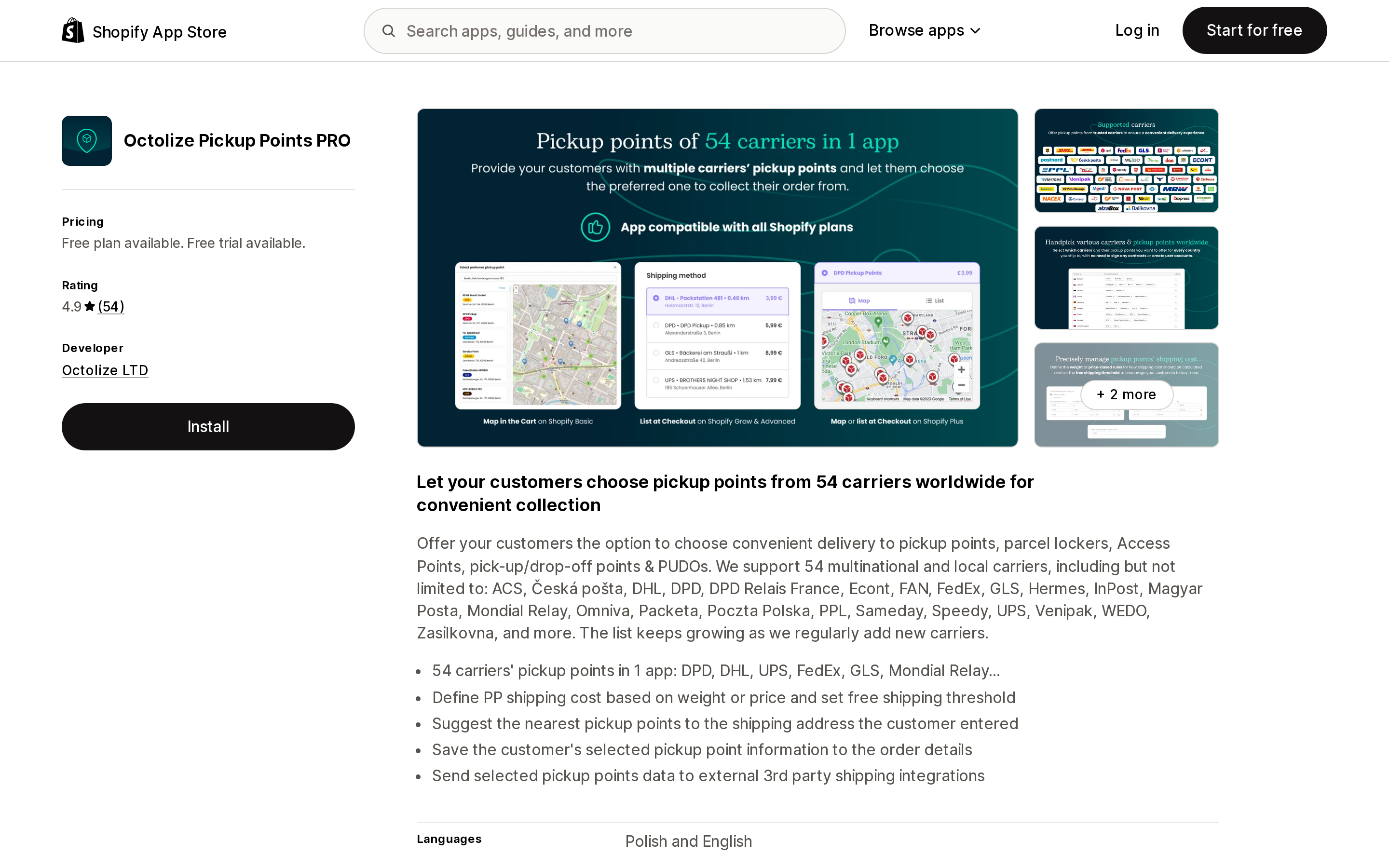
Octolize LTD launched this app on May 30, 2022. It rates 4.9 out of 5 across 54 reviews as of September 3, 2026, does not carry the Built for Shopify badge, and lists 54 carriers including UPS and FedEx.
Pricing is tiered to your Shopify plan: $9.99/month or $99.99/year for Basic with a map in the cart, $14.99/month or $149.99/year for Grow and Advanced with a list at checkout and CCS explicitly required, and $39.99/month or $399.99/year for Plus with a map or list at checkout. The trial is 7 days. The listing shows Free plan available, but that tier is restricted to development stores — not a way to run pickup points on a live store for free.
US coverage is the open question, and the reason this app needs a caveat rather than a recommendation. Octolize lists 54 carriers, UPS and FedEx among them, but the developer does not publish a country-by-country carrier list, so we could not confirm whether US addresses return UPS or FedEx pickup points. The coverage language leans strongly European. Ask Octolize directly before subscribing.
Two structural limits apply regardless. Nearest-point search uses a fixed 25 km radius, roughly 15.5 miles, and the developer's FAQ states that on the in-checkout routes — Shopify Plus, or plans with Carrier Service API access — the app shows no pickup points at checkout when nothing is found inside that radius, leaving only your other configured shipping methods. In suburban and rural US territory that is a real risk. On the Basic tier you also cannot configure delivery cost inside the app — you create rates in Shopify's shipping settings and map them to pickup points by hand.
The vendor's site describes the app in exclusive terms relative to competitors; we did not treat that as verified. Recent reviews come from Lithuania, Spain, and Poland, with support responsiveness mentioned favorably more than once. One three-star review from Spain criticizes the checkout experience, including the absence of automatic geolocation — a single review, not a pattern.
Sendcloud | Shipping Platform
Source: Shopify App Store (Sendcloud | Shipping Platform), retrieved September 3, 2026
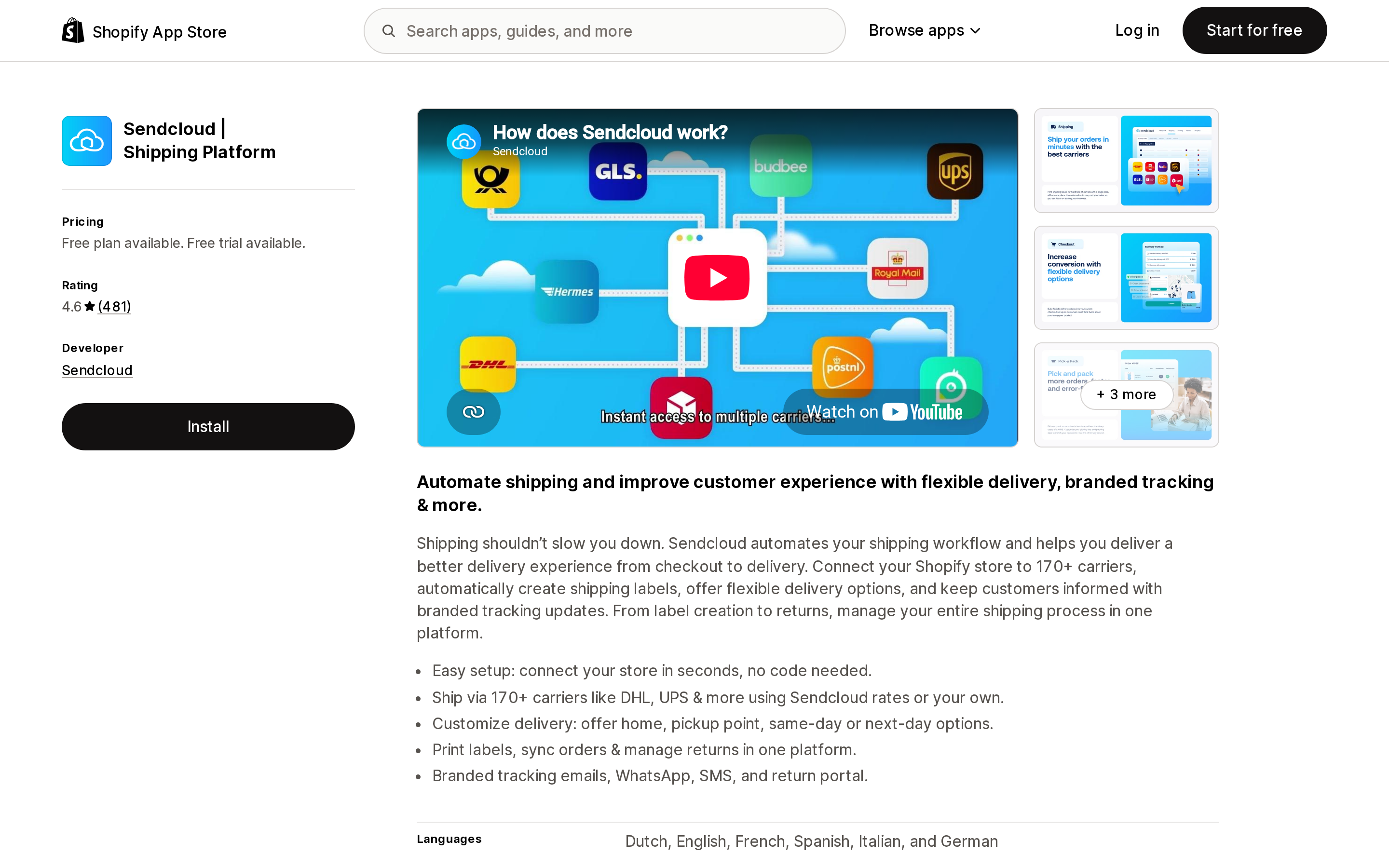
Sendcloud is a different category of product. Launched July 29, 2015, it is a shipping platform covering 170-plus carriers with label generation, tracking, and a returns portal, and service point selection is one feature inside it rather than the whole product. It rates 4.6 out of 5 across 481 reviews as of September 3, 2026 — far more review volume than the other two — though 41 of those, about 9 percent, are one-star.
Pricing runs Free, Lite at $33/month or $315/year, Growth at $99/month or $950/year, and Premium at $195/month or $1,865/year. Note the billing structure: monthly fees are quoted in USD, but per-label charges are quoted in euros at €0.11, €0.10, and €0.09 respectively, and Sendcloud may bill external charges separately from your Shopify invoice. The Free plan lists service points in your checkout, Sendcloud's term for pickup points.
The caution for a US merchant is coverage. The listing's Works with section names DHL, DPD, Evri, PostNL, Royal Mail, and UPS — no FedEx, no USPS — and Shopify features the app under shipping in Germany, France, and Spain. We could not confirm US service point coverage. A France-based merchant of eight years left a review in July 2026 calling the checkout pickup point experience sub-optimal for the customer. Where Sendcloud is clearly relevant to a US stack is as a carrier data source behind another app: Atlas lists it among the connections it can pull pickup points from.
Apps we left out, and why
Three apps that surface in searches for this topic are not in the comparison because they do not serve US shipping. ShipWisely: EU Parcel Lockers — renamed from ShipWisely: Parcel Lockers — describes itself as built for small EU stores and covers the Baltics, Finland, and Poland. Pickup Points & Lockers • AS, from Appsetup Eng., launched August 21, 2026 with EU and Eastern European carriers only, on a pre-checkout form rather than in checkout. PointPicker ‑ Locate & Collect supports Mondial Relay, Colissimo, Chronopost, and Shop2Shop, a French-market carrier set. Each may be a sound choice in its own region; none lists a carrier serving US addresses.
Limits that apply whichever app you pick
Accelerated checkout conflicts with pickup points. Beyond Shopify's own statement about the native feature, Atlas documents that express payment buttons on product and cart pages do not work with pickup point delivery; the issue is reported to Shopify and a fix is still pending. If express buttons drive a large share of your orders, that is a reason to delay this project rather than work around it.
Pickup point apps do not create labels. Atlas says so outright, and Octolize is a pickup point app rather than a shipping platform. The selection lands on the order, and your existing label tool has to consume it.
Sales tax deserves a look. Some configurations write the pickup point address into the order's shipping address. We did not verify how that interacts with US destination sourcing or nexus, and this is not tax advice — but raise it with whoever handles your sales tax before launch.
Choosing
Buyers collect at your own store or warehouse. Use Pickup in store. No app, no fee, and no plan requirement stated in Shopify's documentation.
US store on Shopify Plus, picker inside checkout. Atlas Pickup Points Pro at $69/month is the option we can verify covers US carriers, with checkout blocking to stop orders that have no selection.
US store not on Plus. Atlas Pickup Points Lite at $39/month works on all plans, with selection on the Thank you page. Settle first whether post-payment selection is acceptable to your operations.
Cost is the binding constraint and Europe is your main market. Octolize Pickup Points PRO from $9.99/month is the cheaper of the two dedicated pickup point apps here, and worth it only after written confirmation of US coverage from the developer.
One vendor for pickup points, labels, tracking, and returns, shipping mainly into Europe. Sendcloud consolidates all of it, at the cost of per-label fees and unconfirmed US coverage.
You specifically need USPS lockers or post office collection. No app in this research supports it.
What we could not verify
We found no reviews from US-based merchants for any of the three apps. That is not evidence of a quality problem — Atlas and Octolize both sit at 4.9, and low US review counts are expected in a category built around European carrier networks. It does mean this article cannot tell you how these apps behave at scale on US volume, and no EU review substitutes for that.
We also could not confirm B2B checkout behavior for any of the three, US-timezone support hours, or how they interact with subscription apps. Verify anything on that list against your own requirements before you buy.
Sources
- Setting up shipping to pickup points — Shopify Help Center
- Setting up pickup in store for online orders — Shopify Help Center
- About delivery and shipping functions — shopify.dev
- Generate pickup point options — shopify.dev
- Third-party carrier-calculated shipping — Shopify Help Center
- Setting up shipping zones and rates — Shopify Help Center
- CarrierService resource — shopify.dev
- Pickup Point Delivery Option Generator API reference — shopify.dev
- Atlas Pickup Points — Shopify App Store
- Octolize Pickup Points PRO — Shopify App Store
- Sendcloud | Shipping Platform — Shopify App Store
- ShipWisely: EU Parcel Lockers — Shopify App Store
- Pickup Points & Lockers • AS — Shopify App Store
- PointPicker ‑ Locate & Collect — Shopify App Store
- Atlas Pickup Points official summary
- Atlas Pickup Points — United States carrier coverage
- Atlas Pickup Points — UPS coverage
- Atlas Pickup Points — FedEx coverage
- Atlas Pickup Points — Do I need the Carrier Service API?
- Atlas Pickup Points — Does the app create shipping labels?
- Atlas Pickup Points — Accelerated checkouts and pickup points
- Atlas Pickup Points — Which carriers require credentials
- Octolize Pickup Points PRO — product page
- Octolize Pickup Points PRO — configuration on Shopify Basic without carrier-calculated shipping
Six Shopify direct mail apps priced on incompatible denominators, normalized. Direct Mail Manager lists $0/$5/$10 per month on the App Store while its own pricing page shows $0 or $199 per month plus $0.686 to $0.873 per 4x6 postcard. PostPilot lists as free to install but charges $99 or $499 per month plus per-piece. Poplar Mail's App Store per-piece prices run 8 to 11 percent below its own page, and identity resolution is a separate line at $0.07 per match. Postage is stated as included by only three of the six. Shopify itself has no postal channel, no Flow mail action, and no ZIP code segment filter. Researched September 3, 2026.