
What you will learn
On this pageContentsCloseOpen
Every app in this category has to resolve one thing before it can do anything else: when an order is placed and somebody has to fund a tonne of carbon removal, whose money is it.
There are three answers. The merchant pays out of margin. The customer opts in and pays a surcharge. Or both. That single choice determines the billing model, which surface of your store the app lives on, whether Shopify Plus is a requirement, and — the part almost nobody plans for — what you are permitted to claim in your marketing afterwards.
Shopify itself sits in this category, and Shopify Planet's documentation is the most detailed public description of how any of it works. It is also where you find the constraint most merchants discover after installing: the checkout part of "pay at checkout" is a Shopify Plus feature.
Research date: September 2, 2026. All prices are USD from the English (?locale=en) App Store listings and from the Shopify Help Center.
The short version
Sort the category by who funds the offset and it stops looking like six similar apps and starts looking like three different products.
| App | Who pays | What you are billed on |
|---|---|---|
| Shopify Planet | Merchant, customer, or both — three named plans | Per order; customer contribution is $0.50 USD |
| Ecologi: Plant Trees per Sale | Merchant | $0.80 per tree, $0.28 per kg of carbon removal |
| Greenspark: Plant trees & more | Merchant | Monthly plan plus $0.45–$0.40 per tree, $0.02–$0.01 per kg CO2e |
| ekko: embedded climate action | Customer | "Environmental contributions collected at checkout are invoiced monthly via Shopify billing" |
| CrbonFree: AI Carbon Checkout | Customer | Revenue share: "merchants retain 40% of the total price and pay 60% to CrbonFree app" |
| EcoCart Green Protection | Customer, bundled into a shipping protection fee | Not published on the listing; "External charges may be billed by EcoCart separately from your Shopify invoice" |
All figures quoted from each Shopify App Store listing, US locale, retrieved September 2, 2026.
Two of these six are not really carbon offset apps in the shape the search term implies, and one of them is the app most US listicles still name first.
The unit you are buying is not the same unit
The most useful number on any of these listings is the per-kilogram price, because it is the only figure two apps ever quote in the same units. Then you compare them and the comparison falls apart.
Ecologi lists $0.28 per kg of carbon removal. Greenspark lists $0.02 per kg CO2e on its free tier and $0.01 per kg CO2e on all three paid tiers.
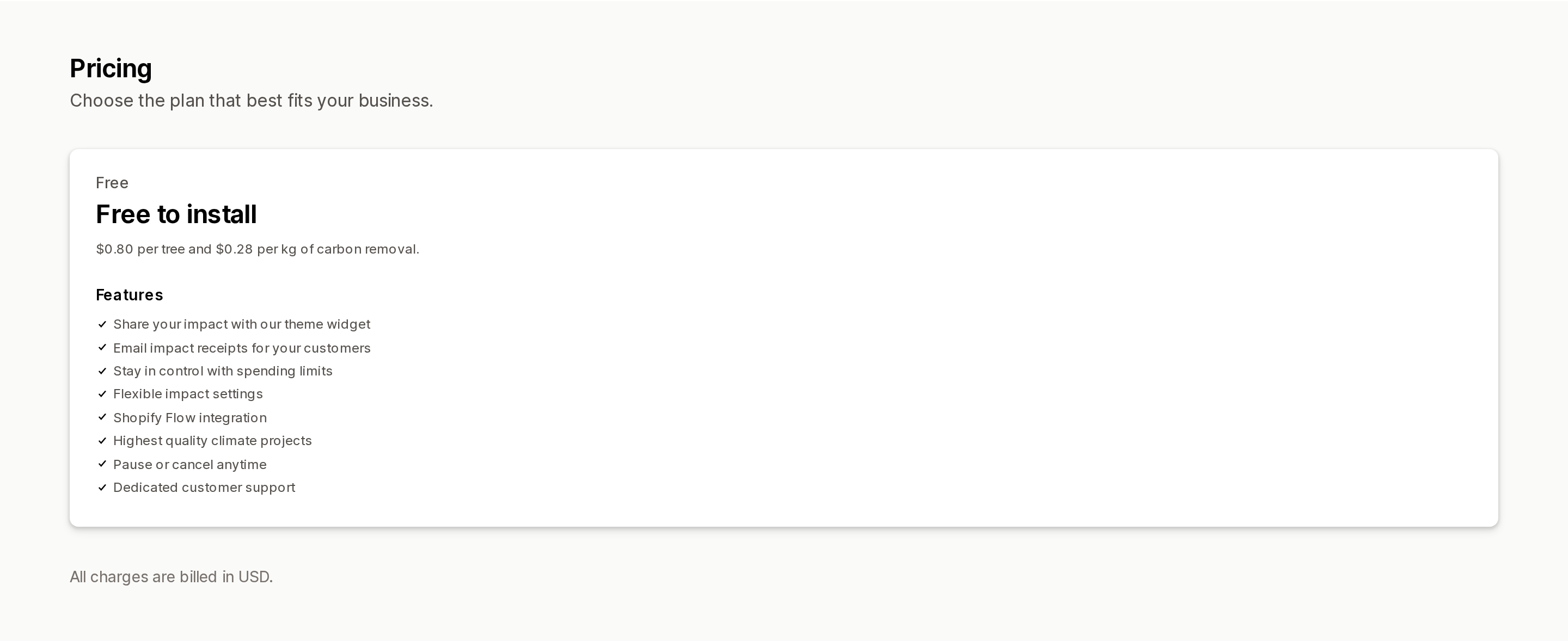
Source: Shopify App Store (Ecologi: Plant Trees per Sale), retrieved September 2, 2026
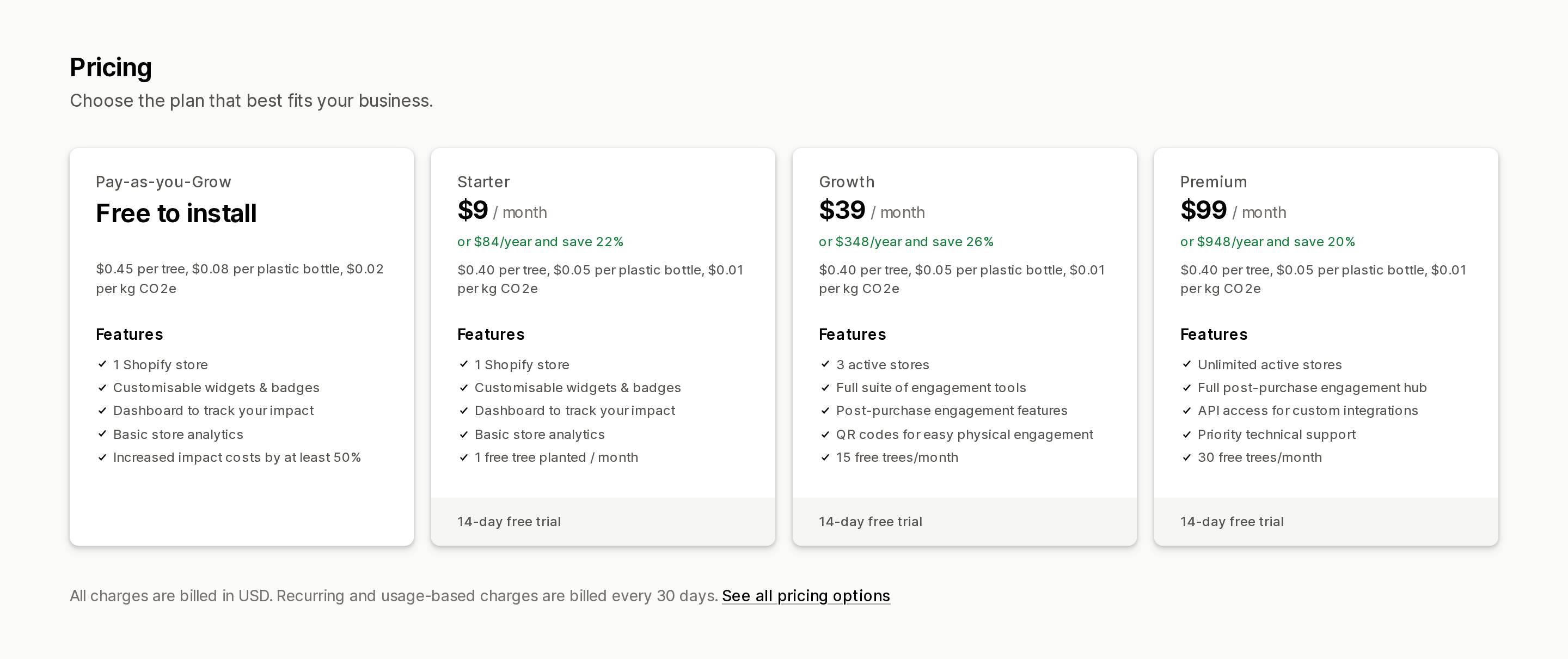
Source: Shopify App Store (Greenspark: Plant trees & more), retrieved September 2, 2026
That is a twenty-eight-fold gap between two apps in the same App Store category, and it is not a discount. Ecologi's listing says "carbon removal" — durable removal, the thing that costs real money. Greenspark's listing says "CO2e," the broader unit that covers avoidance credits as well as removal. Those are different goods with different price floors, and a merchant comparing them on the number alone will conclude that one app is a bargain when it is actually selling something else.
So before you commit, ask the vendor in writing which registry the credits are retired on, whether the project is removal or avoidance, and whether retirement happens now or on a schedule. None of these listings answers that.
The checkout in "pay at checkout" is a Plus feature
Here is the constraint that reorganises the whole decision, and it is documented by Shopify rather than inferred.
The Shopify Help Center page for the Planet checkout extension opens with a plan requirement: the extension "is only available to stores on the Shopify Plus plan." That extension is the thing that lets a customer add $0.50 USD to their order inside checkout.
Non-Plus stores are not shut out of customer contributions, but the surface changes. Planet's badge has two modes, and Engagement mode is "an interactive badge that lets your customers add $0.50 USD to their checkout." It goes on your theme — home page, cart, wherever a compatible theme lets you place a block — not inside the checkout flow. So the customer opts in before checkout rather than during it, which is a different conversion problem entirely.
The same wall shows up on a competitor's listing. Replying publicly to a review on May 18, 2026, Ecologi wrote that "Shopify only let's us edit the checkout if you are a Plus store" and that a customer-funded feature "exists but is only available for Plus customers." Four months earlier, on January 16, 2026, Ecologi had replied to a different review that both delivery emissions and "allowing your customers to fund impact on your behalf" were "on our radar as potential future" work. The two replies do not sit comfortably together, which is itself worth knowing before you build a launch campaign on a feature request.
The app that markets its way around this is ekko, whose listing leads with "Works on every Shopify plan." Launched April 30, 2026 by ekko Earth Limited of London, it holds 5.0 across 2 reviews — which is to say, almost no third-party evidence at all. But its billing model is the cleanest customer-pays design in the set: free to install, no monthly fee, and contributions collected at checkout invoiced monthly through Shopify billing.
Planet covers shipping, and only shipping
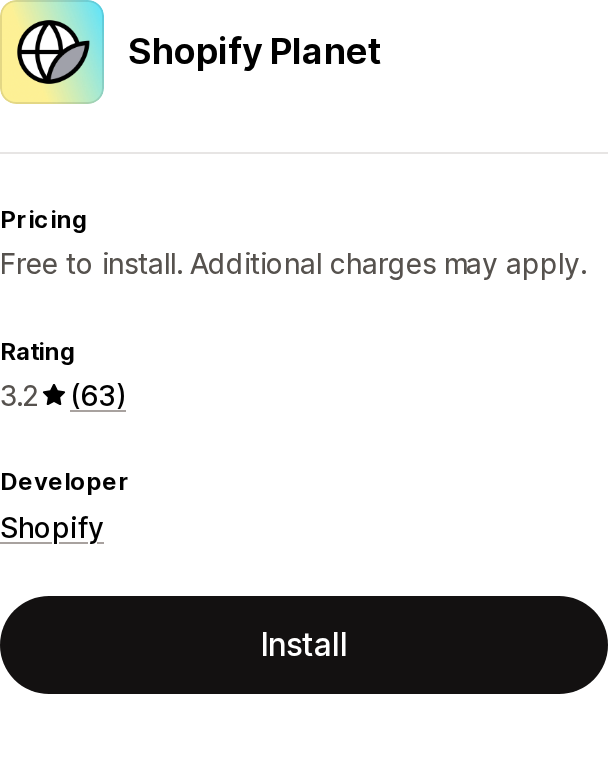
Source: Shopify App Store (Shopify Planet), retrieved September 2, 2026
Shopify Planet launched June 2, 2022 and holds 3.2 across 63 reviews — comfortably the lowest rating in this comparison, and worth reading rather than dismissing. It is free to install, and the listing states you have "3 subscription options ranging from $0.00 to $0.15 per order."
What it offsets is narrow, and the documentation is honest about it. Planet estimates emissions from three inputs: weight, distance, and type of transportation. Nothing about manufacturing, materials, packaging, or returns enters the calculation. If you install Planet and then write "carbon neutral" without qualification anywhere on your site, you have widened the claim past what the app supports.
Two more details merchants rarely see. When tracking data is missing or the carrier is unsupported, Planet multiplies estimated emissions by an uncertainty factor of 3 — a deliberate overestimate, in your favour environmentally and against you on the invoice. And the estimates cover CO2 only; the documentation states that "the emissions estimated don't account for the release of other greenhouse gases during transportation."
The three plans are All shipments carbon neutral (you pay), Customers choose (customers pay $0.50 USD), and the Combined option (both, and it requires a compatible theme). Carbon removal comes in three grades — Decade, Century, and Millennium — with Decade using nature-based projects and the other two mixing in direct air capture and enhanced rock weathering.
And the line that no third-party app in this set matches: "Shopify doesn't take a cut—100% of funding goes to carbon removal projects."
The budget cap that switches your claim off
Buried in Planet's subscription documentation is the single most consequential operational detail in this whole category.
You set a monthly budget. If you reach it, "payments from you and your customers are paused until you increase your limit or the next billing cycle begins." If you exceed it, badging on your online store is deactivated until the balance clears. And then Shopify says the quiet part in its own help centre: you are "under no obligation to clear the balance, and are still having a positive impact with the app, but cannot claim that all shipments are carbon neutral."
Read that as a compliance control, because that is what it is. A budget cap hit during a Black Friday spike silently converts a store that offsets every shipment into a store that offsets some of them — while your product pages, your email footer, and your packaging inserts all still say every order is carbon neutral. Nothing in the app rewrites your marketing copy for you.
Read the revenue share twice
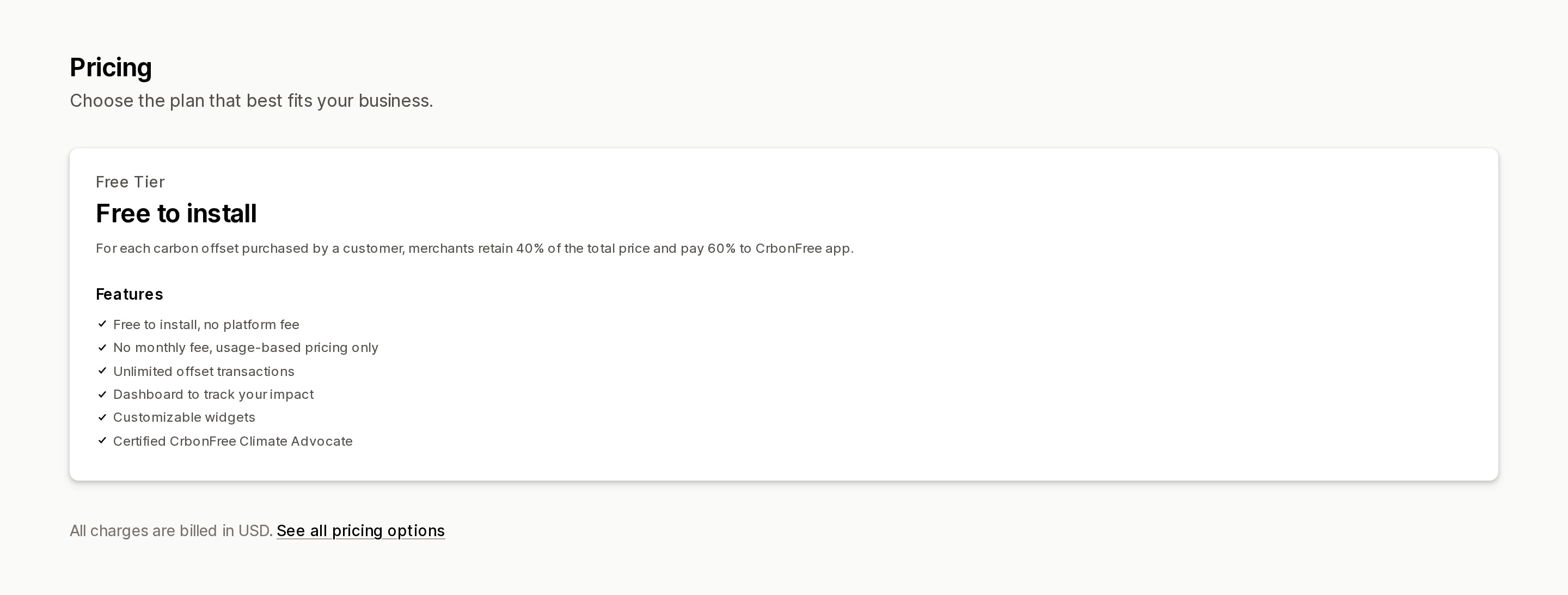
Source: Shopify App Store (CrbonFree: AI Carbon Checkout), retrieved September 2, 2026
CrbonFree, by Crbon Labs Inc. of Calgary, launched October 29, 2025 and holds 5.0 across 1 review. Its pricing card reads, in full: "For each carbon offset purchased by a customer, merchants retain 40% of the total price and pay 60% to CrbonFree app." The listing summary is equally direct — "Earn revenue share on every fee to grow your margin."
There is nothing hidden here; the developer has published the arrangement on the pricing card, which is more transparency than several competitors offer. But it is a materially different proposition from the rest of the category. In Planet's model, 100% of what a customer contributes goes to carbon removal. In CrbonFree's model, 40% of what a customer pays for a carbon offset stays with the merchant as margin, and the offset itself is funded from the remaining 60% after CrbonFree's own costs.
If you run this, the customer-facing copy has to survive a customer reading the pricing card. "Add $2 to make this order carbon neutral" and "add $2, of which we keep $0.80" are not the same sentence.
What the FTC Green Guides actually say
I am not a lawyer and this is not legal advice. But the relevant text is short, public, and worth reading before you paste an app's marketing copy onto your product page.
Carbon offset claims sit in 16 CFR § 260.5, part of the FTC's Guides for the Use of Environmental Marketing Claims. Three points, paraphrased tightly:
- Sellers "should employ competent and reliable scientific and accounting methods to properly quantify claimed emission reductions and to ensure that they do not sell the same reduction more than one time."
- It is deceptive to imply a reduction has already happened when it has not; marketers "should clearly and prominently disclose if the carbon offset represents emission reductions that will not occur for two years or longer."
- It is deceptive to claim an offset represents a reduction "if the reduction, or the activity that caused the reduction, was required by law."
The status of this text matters. The eCFR records its source as 77 FR 62124, October 11, 2012, and notes no changes to this section after January 3, 2017. And despite an FTC review of the Green Guides that opened in December 2022, the FTC's own Green Guides page — retrieved September 2, 2026 — still describes the Guides as "first issued in 1992 and were revised in 1996, 1998, and 2012." If you have read that the Guides were updated more recently, check it against the primary source before relying on it.
Three consequences for a Shopify store. The subscript under an app's badge is your claim, not the vendor's — you published it. If your app funds projects that deliver reductions years out, § 260.5(b) points at a disclosure you probably are not making. And § 260.5(c)'s own worked example concerns methane capture that state law already required, which is a fair question to put to any vendor whose projects involve methane, including CrbonFree's stated work "plugging old methane wells." Ask; do not assume.
The apps, briefly
Ecologi: Plant Trees per Sale — by Ecologi, London, launched March 12, 2020, 4.8 across 36 reviews, and the only app in this comparison carrying the Built for Shopify badge. Free to install at $0.80 per tree and $0.28 per kg of carbon removal, with spending limits, impact emails to customers, and Shopify Flow integration. Merchant-funded by design. A January 15, 2026 review from a UK merchant of over four years asks for exactly the two things the app does not do — customer-funded contributions and shipping emissions calculation — and Ecologi's reply confirms both are unbuilt. Poor fit: anyone who needs the customer to pay, on a non-Plus store.
Greenspark: Plant trees & more — by Conscious Ventures Ltd, Deal, England, launched October 22, 2021, 5.0 across 57 reviews. The only app here where the monthly fee is essentially a volume discount on impact: the free Pay-as-you-Grow tier states "Increased impact costs by at least 50%," and Starter at $9/month (or $84/year) drops trees from $0.45 to $0.40 and CO2e from $0.02 to $0.01 per kg. Growth is $39/month for 3 stores, Premium $99/month for unlimited stores and API access. The arithmetic is easy: $9/month buys back $0.05 per tree, so Starter pays for itself at 180 trees a month, or at 900 kg CO2e. Below that, the free tier is cheaper. Its listing does not publish a Data access section. Poor fit: stores wanting customer contributions — the listing does not describe one.
EcoCart Green Protection — by EcoCart, San Francisco, launched May 14, 2020, 4.9 across 89 reviews. The name change tells the story: this is now a shipping protection product combining protection, claims management, cashback rewards, and climate impact. If you arrived here searching for a carbon offset app, this is not one anymore; the offset rides along inside a protection fee the customer pays. Its listing publishes no pricing tiers and no Data access section, and notes that "External charges may be billed by EcoCart separately from your Shopify invoice." Several 2023–2024 reviews from US merchants describe unanswered support and repeated overbilling, with a developer reply acknowledging an erroneous charge. Poor fit: anyone who wants a standalone offset line item, or wants to audit permissions before installing.
Two more worth naming. Tree-Nation: 1 Product 1 Tree (Brussels, launched July 29, 2020, 4.9 across 10) quotes "starting at €0,35/tree" on a listing that also says all charges are billed in USD — a currency mismatch to resolve before budgeting. And CarbonClick, which older US comparison articles still recommend, now returns a stub page reading "This app is not currently available on the Shopify App Store."
How to choose
- You want the customer to pay, inside checkout: Shopify Planet, and you need Shopify Plus for the checkout extension.
- You want the customer to pay and you are not on Plus: Planet's badge in Engagement mode, or ekko, whose listing states it works on every Shopify plan.
- You want to pay for it yourself and say so: Ecologi if you want the Built for Shopify badge and Shopify Flow; Greenspark if you are past 180 trees or 900 kg CO2e a month, where its paid tiers get cheaper per unit.
- You want shipping emissions specifically, calculated from real tracking data: Shopify Planet. It is the only app here that documents its emissions method.
- You want offsets bundled into a shipping protection offer: EcoCart Green Protection, with the support history read first.
- You are evaluating a revenue share: CrbonFree publishes its 40/60 split on the pricing card. Decide whether your storefront copy can carry it.
What the listings do not say
What happens to the checkout contribution item when you uninstall. No listing in this set states it. A Planet review from a US merchant on June 9, 2026 describes fraudulent $0.50 orders placed with the Planet item as the only line in the cart, and Shopify's reply on June 23, 2026 says restricting that "isn't something we can do" — evidence that the contribution behaves as a purchasable item in the order stream, with all that implies for reporting and for what an uninstall leaves behind.
Which registry credits are retired on, and when. Not stated by any of the six.
Whether removal and avoidance are mixed. Only Planet names its removal types. The rest publish a unit price and a project story.
EcoCart's and Greenspark's permission sets. Neither listing publishes a Data access section, so they cannot be audited before install the way Planet, Ecologi, ekko, and CrbonFree can.
Sources
- Shopify Planet — Shopify App Store
- Ecologi: Plant Trees per Sale — Shopify App Store
- Greenspark: Plant trees & more — Shopify App Store
- EcoCart Green Protection — Shopify App Store
- ekko: embedded climate action — Shopify App Store
- CrbonFree: AI Carbon Checkout — Shopify App Store
- Reducing your environmental impact with carbon-neutral shipping options — Shopify Help Center
- Adding the Planet checkout extension to your online store — Shopify Help Center
- Adding the Planet badge to your online store — Shopify Help Center
- Calculating your shipping emissions — Shopify Help Center
- 16 CFR § 260.5 Carbon offsets — eCFR
- Green Guides — Federal Trade Commission
Two claims still dominate US wholesale advice: that Shopify B2B is Plus-only, and that Shopify has no native wholesale signup. Both are out of date. Since the April 2, 2026 changelog, B2B runs on Basic, Grow, Advanced and Plus, and the free Shopify Forms app collects company account requests that sit under Customers > Companies > Ordering not approved until a merchant approves them. What is still missing: no way to add a buyer to an existing company, rejection means deleting the company record, and the form cannot run on a gated store. Five apps from $0 to $150/month close different parts of that gap, and they split into two different architectures. Researched September 3, 2026.